From the outside it looks like a miniature palace: a plinth, columns, gilt bronzes, a domed clock. But the façade is only a curtain. Turn a key, press a hidden button, and the piece begins to move: little doors spring open of their own accord, a writing slope unfolds without a sound, drawers give onto further drawers hidden deeper still — and yet others known to the owner alone — while a chiming mechanism plays a tune to accompany it all. David Roentgen’s Berlin secretary cabinet, now in the Kunstgewerbemuseum, is reckoned the most expensive and most complicated piece of furniture ever built. A short film in which curators open its secrets one by one has circulated online for a decade and drawn millions of views. Two hundred and forty years after its debut, the piece still does exactly what it was designed to do: it leaves the viewer speechless.
Curators at the Metropolitan Museum open the successive mechanisms of the secretary cabinet made for Frederick William II — writing slopes, drawers and hidden compartments released by pressing concealed buttons and turning a key. The sequence in which the piece unfolds was in effect a form of security: only the owner knew it. “The Roentgens’ Berlin Secretary Cabinet,” The Metropolitan Museum of Art, 2012 (official YouTube channel).
That film was not a one-off. It came out of Extravagant Inventions: The Princely Furniture of the Roentgens, the exhibition the Metropolitan mounted from 30 October 2012 to 27 January 2013 — the first comprehensive American survey of the workshop, some sixty pieces of furniture and clocks gathered from royal and museum collections across Europe and beyond, several of them never lent before. Its curator, Wolfram Koeppe, had the most intricate mechanisms filmed and animated so that visitors could watch them work; the catalogue he edited remains the standard reference on the Roentgens, and it stands behind much of what follows here.
But the most interesting thing is not how these pieces worked; it is where they came from. They were not made in Paris, London or Vienna, but in a small town on the Rhine, in the workshop of an austere religious community that held luxury to be morally suspect, gambling a sin, and humility the principle organising the whole of life. The very people who on Sundays sang of the vanity of worldly things were building desks for Versailles, Berlin and the Hermitage.
This tension between faith and luxury is not the background to the story but its mechanism. It would lead to a family rupture, to a son’s expulsion from the community, to one of the stranger episodes in the history of the furniture trade — a lottery at which one might win a masterpiece — and, finally, to a letter commending a cabinetmaker to an empress as one commends an ambassador.
A COMMUNITY THAT HELD LUXURY TO BE A SIN
The story begins not in a workshop but in an ascetic religious community.
The Moravian Brethren — also called Herrnhuters, and officially the Unity of the Brethren — were heirs to the Bohemian Brethren, a Protestant movement whose roots reached back to Jan Hus. After the Thirty Years’ War, persecuted in Moravia by the Catholic authorities, they fled north; in 1722 a group of German-speaking brethren settled in Saxony, on land granted them by the family of Count Nikolaus Ludwig von Zinzendorf. They named the settlement Herrnhut — “under the Lord’s watch” — and from it the whole movement took its name.
The community’s life was organised around a principle that sounds like the negation of everything one associates with furniture for kings: one worked for God, for one’s neighbour and for the community, not for personal gain. Private property was regarded with suspicion; a member’s wealth was entrusted to him for stewardship rather than owned outright. Services were held in bare halls, the day began with a scriptural “watchword,” and in moments of uncertainty decisions were reached by drawing lots, in the belief that God himself spoke through them.
And yet that same spirituality proved an excellent environment for craft. Unmarried brothers and unmarried sisters lived apart, in “choir houses” that functioned in practice as pre-industrial manufactories — potteries, clockmakers’ and goldsmiths’ shops. The profits funded missions, and the missions flung out, within a single generation, a network of stations from the Caribbean through Greenland to the Himalayas; the community, forever under threat of exile, kept up wide-ranging commercial contacts and held its capital in liquid form, lent from member to member. Scholars sum it up as a mutual reinforcement of fervour, modest consumption, economic success and stern morality. Contemporaries saw it more simply. In 1785 the Prussian count Philipp Otto von Dönhoff wrote to a cousin that among “these dear people,” as everyone knew, one would find the best manufactories and the best craftsmen (quoted after Koeppe 2012). Piety performed the function a brand would later take over: it was a public guarantee of quality.
Herrnhaag, near Büdingen — the settlement of the Moravian community to which Abraham Roentgen came after returning from his failed missionary voyage, and where his son David was born in 1743. The colony was raised in the 1730s and 1740s almost from nothing; soon after the Roentgens left, the community was forced to abandon it, and the sprawling buildings never returned to their former role. The view dates from 1835, close to a century after the events described here. Licence: “DE Büdingen Herrnhaag 1835 1.jpg,” artist unknown, 1835. Wikimedia Commons, public domain.
Abraham Roentgen — born in 1711 in Mülheim near Cologne, the son of a joiner — came to this world by a roundabout path. His journeyman years, from 1731 to 1738, he spent in Holland and London, where, as his younger son would later record, he specialised in engraving, marquetry and mechanisms, and where the finest masters competed for him. There, too, he attached himself to the Brethren. He took his conversion seriously: in 1740 he abandoned a promising career and set out as a missionary across the ocean.
Nothing came of the voyage. On the eve of embarkation Abraham’s wife was delivered of a stillborn daughter; he himself, leaving her in the community’s care, sailed on. The ship, harried along the way by a Spanish privateer, took shelter in the Irish port of Galway and there sank at the quayside — reportedly because rats had gnawed through the hull. The legend of Roentgen the castaway, repeated for decades afterwards, was thus an exaggeration; the reality proved at once less dramatic and more absurd. Abraham returned to Europe a few weeks later, having paid for the passage with his own labour, and never sailed for the missions again.
He began from nothing: he reached the Brethren’s settlement at Herrnhaag near Frankfurt without tools of his own, and at first worked in the borrowed workshop of a retired joiner. There, in 1743, his son David was born. And when, in 1750, the local count withdrew the community’s welcome and the Brethren had once more to pack up, Abraham chose the direction that would decide everything: Neuwied on the Rhine.
The count there, keen to revive his miniature statelet, offered the Brethren terms a craftsman elsewhere could not even have dreamed of: freedom of worship, tax relief, and exemption from the guild rules — including the limit of two assistants per master. That last point, the most technical-sounding, weighed the most. No guild would ever have let a single workshop grow to two hundred people; all the later marvellous machines of Neuwied have their legal origin in that exemption.
The paradox with which this essay opened, then, has an economic architecture. Piety did not hinder the Roentgens in the production of luxury — it was its infrastructure: it supplied an ethos of quality, a discipline of work, a network of contacts and a line of trust. The conflict began only at the point of sale. And selling was to be David’s business.
THE LOTTERY
Towards the end of the 1760s the Neuwied manufactory stood on the brink of bankruptcy. The problem was structural: the aristocracy ordered readily but paid late or not at all, and the workshop financed its costly production out of its own pocket. On top of this, a stock of finished furniture was piling up in the stores just as fashion was turning away from the Rococo — the value of the inventory melting away with every season.
The solution was proposed by David, at that point still formally no more than the owner’s son. In Neuwied it sounded like a provocation: a lottery. Put up the accumulated furniture as prizes, sell tickets across the Empire, turn stagnant goods into cash and, along the way, into publicity.
The idea itself was not new. Goods lotteries had been known in the Low Countries since the fifteenth century — weavers in Delft and glassmakers in Middelburg ran them, and in 1695 the Antwerp joiner Henrick van Soest disposed of his entire unsold stock this way. The eighteenth century was, in any case, a century of gambling: courts, salons and the middle classes all played. But what was permitted to Antwerp was not permitted to Neuwied. For the Brethren, games of chance for profit were morally unacceptable; in 1768 the publicist Justus Möser called the general enthusiasm for lotteries a monument to the corruption of morals — and the Neuwied community thought exactly the same.
The father objected. The congregation objected, and actively so. The elders had long looked askance at David’s worldly ambitions; the community’s records preserve the verdict that he was “the evil spirit of the family,” and the mounting dispute ended in his expulsion. The same community that drew lots to learn the will of God judged a drawing in the service of the firm to be a sin. The lot might decide the affairs of God — it was not to rescue the business.
Agreement was reached only through the mediation of Count Wied, lord of the town and protector of the Brethren. David submitted his application to the Senate of Hamburg on 17 June 1768; consent came twelve days later. The choice of city was no accident: the Hamburg lotteries, conducted under the supervision of the town councillors, were held to be models of probity, and the city itself was, alongside Frankfurt, the busiest commercial centre of the Empire. In the press announcements David styled himself an “English cabinetmaker” — a description closer to aspiration than to fact, for he had never been to England. It was his father who had trained in London.
The drawing took place on 29 May 1769. All 715 tickets sold, at about eighteen guilders apiece — the equivalent of six weeks’ work for a skilled journeyman. The list of prizes reads today like an inventory of an eighteenth-century apartment in cross-section: desks and secretaries, writing tables, tables for games and for needlework, night cabinets — a piece for every activity for which the household of the day had a separate name. The chief prize was a desk with a superstructure, which David described in the prospectus with undisguised pride: “Chinese figures […] so perfect in drawing, shading and colour that they may boldly be compared to the work of a painter — and all of it made from wood alone” (Hamburg lottery prospectus, 1768; quoted after Koeppe 2012; translation the present author’s). Inside waited a carillon clock and a hidden clavichord. The piece, taken for lost for two centuries, was recently identified in the collection of Designmuseum Danmark in Copenhagen. It was won by a Hamburg grain merchant, who was fairly quick to be rid of it — in a bourgeois interior it was simply too much.
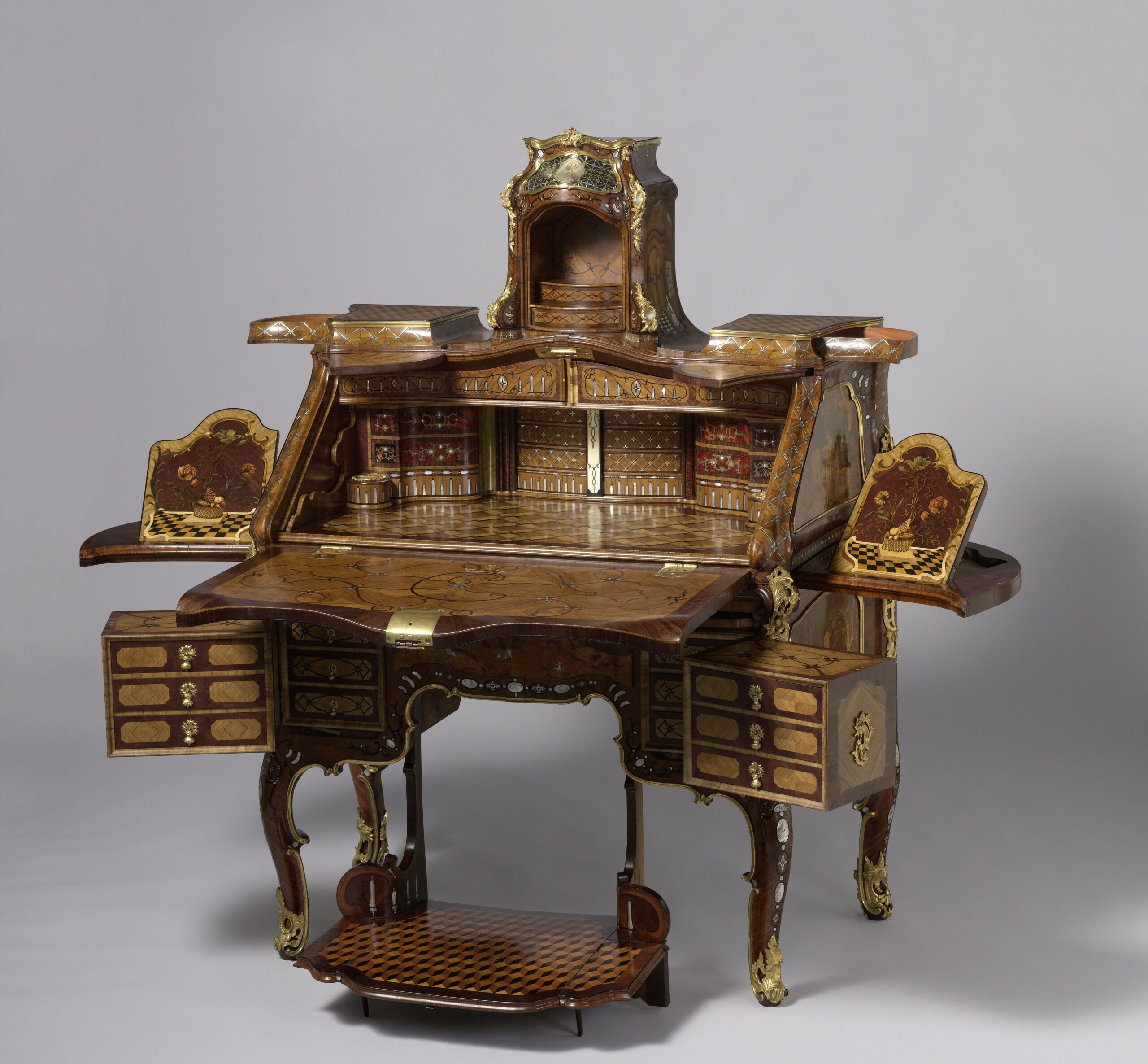 The finest work of Abraham Roentgen, David’s father, made for Johann Philipp von Walderdorff, Archbishop-Elector of Trier — shown here open. The side drawers slide out, the writing slopes with their floral marquetry fold down, and the superstructure with its arcaded niche opens; the whole is composed of many kinds of wood together with tortoiseshell, silver, mother-of-pearl and ivory. The desk was made before the workshop’s breakthrough years, yet it already shows everything the next generation would become famous for: a picture made in wood and a piece full of secrets. Licence: “Bureau, BK-16676.jpg.” Abraham Roentgen, desk for the Archbishop-Elector of Trier, Neuwied, c. 1758–1760. Rijksmuseum, Amsterdam (inv. no. BK-16676, CC0 / public domain).
Financially, the lottery saved the workshop. In marketing terms it did something more. Tickets were bought by courts and great houses — Margravine Karoline Luise of Baden, a faithful Neuwied client, took thirty and won a small table, a night cabinet and two trifles — and from that moment “Neuwied furniture” began to appear in the inventories of families whose roll reads like the Almanach de Gotha. The historian Michael Stürmer called the Hamburg lottery prospectus the “Rosetta Stone” of the Roentgens’ early output: dozens of meticulous descriptions still allow scholars to identify the forms the workshop developed in its first decades.
David came out of this episode as something more than a gifted son of a gifted father. He grasped a thing no one else in the trade then understood: that demand for luxury can be manufactured, not merely served — and that the client you travel to is worth more than the client you wait for. On that lesson he would build the rest of his career: tours of the courts, depots in Paris and St Petersburg, the journey to the Neva with Grimm’s letter. But to understand what he was actually trading in, one has to look inside his furniture.
FURNITURE AS MACHINE
The eighteenth-century viewer had no ready category for objects like the Berlin secretary cabinet: this was no longer cabinetmaking, and not yet engineering.
Technically, the marvels of Neuwied were driven by springs, catches and counterweights; in the largest secretaries — the Berlin one foremost among them — the moving elements were set going by falling weights, exactly as in clocks. That resemblance has an address. A few doors down from the Roentgens, in Neuwied, worked the clockmaker Peter Kinzing, and the division of roles between the two shops was constant: the case, the marquetry and the joiner’s mechanics were made at Roentgen’s; the clocks, carillons and automata at Kinzing’s. The title Marie Antoinette would later confer on David — ébéniste mécanicien, cabinetmaker-mechanic — was in truth a title for them both.
The status of these mechanisms is best shown by an episode from the summer of 1779: Christoph Willibald Gluck — a composer over whose operas a regular war of factions was then being waged in Paris — supplied eight pieces written for a Roentgen longcase clock standing in the house of the Austrian ambassador. The greatest operatic composer of the age was writing a repertoire for a piece of furniture. Five years later the crowning fruit of this collaboration reached Versailles: an automaton of a dulcimer player with the features of Marie Antoinette, playing Gluck’s melodies. The queen received it in December 1784 and in March passed it to the Academy of Sciences. The automaton works to this day; it can be seen in the Musée des arts et métiers in Paris.
 The dulcimer-playing automaton with the features of Marie Antoinette, built by David Roentgen with the clockmaker Peter Kinzing. Driven by a clock movement, the figure moves its head, eyes and hands, striking the strings of the dulcimer with little hammers. The queen received it late in 1784 and within a few months passed it to the Paris Academy of Sciences — more as a scientific object than a toy. The mechanism still works. Licence: “Dulcimer player-CnAM 7501-IMG 5548-gradient.jpg,” David Roentgen and Peter Kinzing, 1784. Musée des arts et métiers, Paris. Photo Rama, CC BY-SA 3.0 FR.
 The figure was made with care for a portrait likeness of the queen; eighteenth-century viewers were moved by the “breathing” motion of the chest and by a gaze that seemed to follow the playing. Licence: detail of “La joueuse de tympanon.” Photo Jean-Pierre Dalbéra, CC BY 2.0.
It is worth saying what these objects were in the typology of their age — for the eighteenth century is the moment when the European interior specialised its furniture as minutely as never before or since. A separate table for games, a separate one for needlework, for the toilette, for breakfast; a flat writing desk for display and a secretary for secrets. The Roentgens served this whole repertoire, but two types became their signature: multi-function tables, in which the top, the reading slopes and the easels unfolded from a single body into a dozen configurations, and the cylinder desk. This second invention — perfected in parallel by the Paris masters, Oeben and Riesener foremost among them — solved at a stroke a problem familiar to anyone who works at a desk: a tambour cylinder closed away in half a second the whole clutter of correspondence, papers and secrets, leaving an immaculate object in the room. The writing desk was becoming a desk for shutting things away.
The other half of the Neuwied genius was the surface. The Roentgens’ marquetry was called painting in wood, and this was no courteous metaphor. Where others added detail with the graver or scorched shadows in with hot sand, the workshop assembled its chiaroscuro from motes of differently coloured wood, piece by piece; David himself boasted in the Hamburg prospectus that his Chinese scenes could stand comparison with the work of a painter, though there was not a trace of paint in them. The Neuwied polish had a fame of its own — a traveller’s account survives of a table polished so finely that the illusion of marble deceived both eye and hand. The manufactory kept a specialist for polishes and lacquers alone. And when fashion swung towards Classicism, David executed a volte-face of the kind only the self-assured can afford: the marquetry for which he was famous he gradually set aside in favour of smooth planes of noble mahogany framed in gilt bronze. Ornament gave way to proportion and material — and those late, restrained pieces still look surprisingly modern today.
A cylinder desk from the workshop’s mature phase — still fully “painted in wood.” The Chinese scenes on the cylinder and sides were assembled from motes of naturally coloured exotic woods after drawings by the painter Januarius Zick; a painterly effect only Roentgen achieved. The piece also betrays his love of mechanisms: turning a key opens the side drawers, and a hidden button reveals further, concealed compartments. The marquetry that slides into the top was set in maple fields, probably stained grey, which set off the Chinese scenes like a theatrical backdrop. Ten years later the same workshop would abandon such decoration for the smooth, gleaming planes of the desk below — no whim of a single cabinetmaker, but a turn of the whole age towards Classical restraint. File / licence: David Roentgen, cylinder desk with chinoiserie marquetry (after Januarius Zick; handles after a pattern by Thomas Chippendale), Neuwied, c. 1776–1779. The Metropolitan Museum of Art, New York (inv. no. 41.82, public domain).
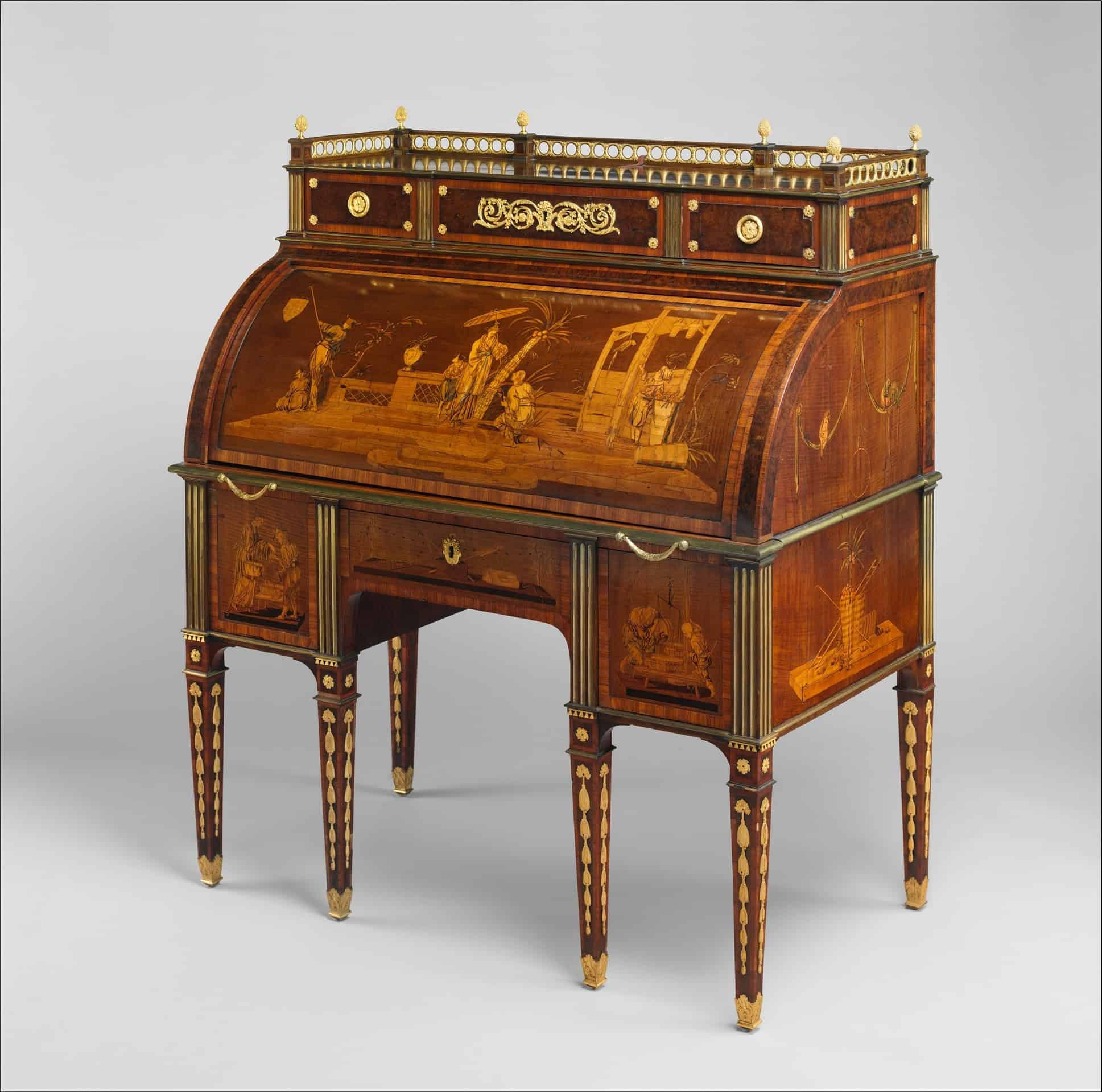
A cylinder desk from the workshop’s late, Classical phase — the same type in which Roentgen replaced dense marquetry with smooth planes of rare wood and gilt bronze. The distinctive yellow tone comes from a veneer of exotic pau amarello; in sunlight the surface seems to glow from within. The cylinder slides back into the body, revealing compartments with spring-loaded hidden drawers. The object is most probably the “small desk of yellow wood, 250 roubles” listed on an invoice of 23 March 1786 among the furniture delivered to Catherine II. File / licence: David Roentgen, cylinder desk, Neuwied, c. 1785–1786. The Metropolitan Museum of Art, New York (inv. no. 2018.288.1, public domain).
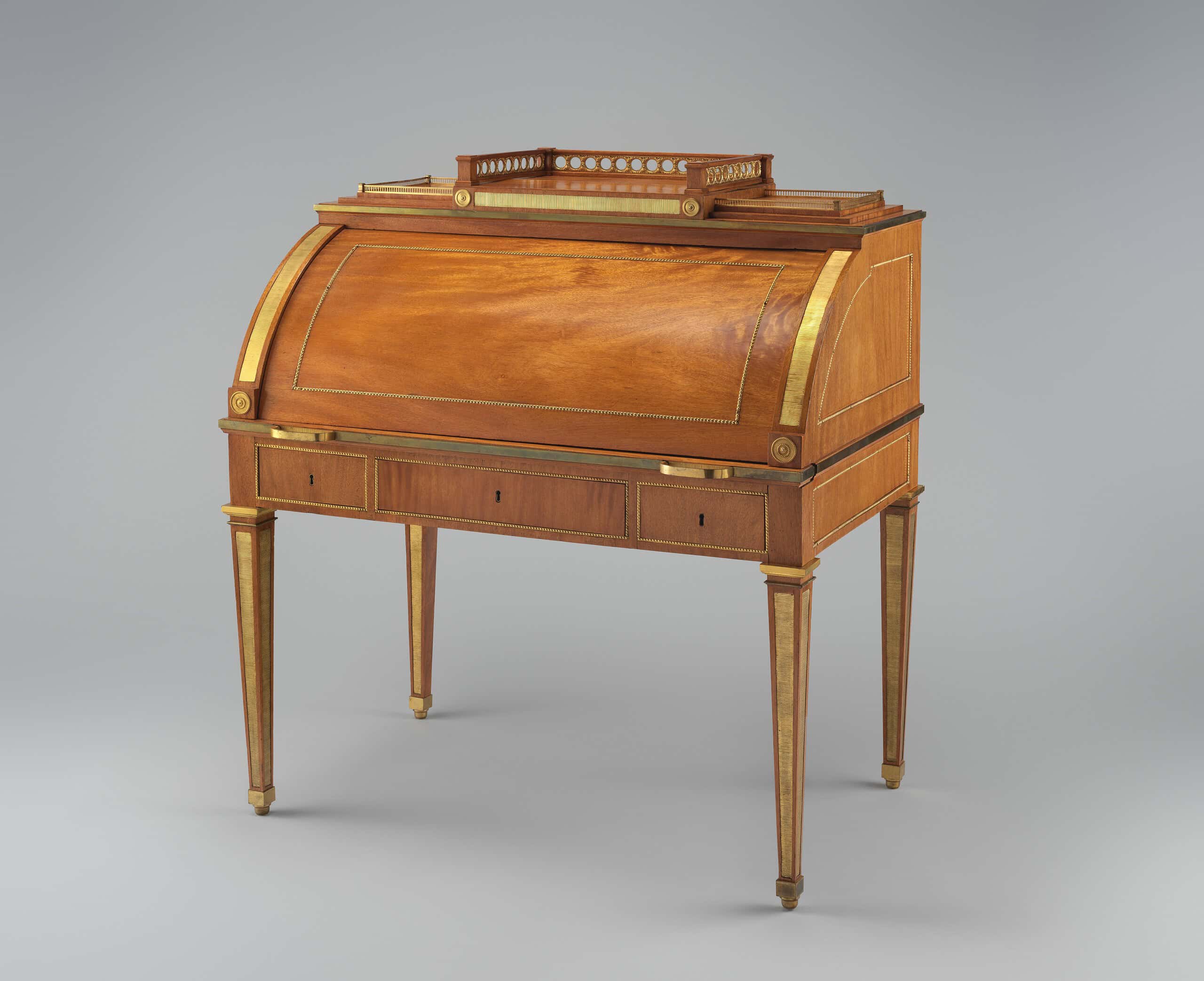
At this scale, “by his own hand” is a fiction — a romantic one, but a fiction. The Neuwied fabrique, for so it was already called, employed at its height nearly two hundred specialised craftsmen from all over Europe, and its annual revenues in the 1780s not infrequently matched those of the Meissen porcelain manufactory. The work was divided: cases apart, marquetry apart, bronzes, mechanics, polish. When Adam Smith, in those same years, described the division of labour in a pin factory as a machine for lowering costs, at Neuwied the same mechanism worked in the opposite direction — not towards cheapness but towards perfection. The client, moreover, did not so much order a piece as configure it from a repertoire of possibilities: more hidden compartments, a carillon clock, an automaton, bronzes. The base was shared; luxury began in the options.
An organisation like this needed only an audience that could afford the ticket.
AT THE COURTS OF EUROPE
To understand why monarchs paid the price of palaces for these objects, one must step back from the furniture for a moment and look at the rooms in which it was to stand. The eighteenth century rearranged the way elites lived more deeply than any century before it: alongside the ceremonial enfilades, where life was conducted before the eyes of the court, there grew up small private rooms — cabinets, dressing rooms, boudoirs. With them was born a new need: for furniture for private life, not ceremonial life. And the private life of the age was conducted above all on paper. This is the century of the letter — diplomatic, philosophical, amorous — and the century of the writing furniture that keeps letters. The secrétaire carries the secret in its very name: the French secrétaire descends, by way of the secretary, from the Latin secretum. A desk with locks, hidden drawers and spring-released compartments was therefore no caprice: it was a technology of privacy in a world where the servants held keys to everything and where correspondence could be politics. Roentgen sold the courts precisely that double good — spectacle for show and discretion for every day, shut up in a single body.
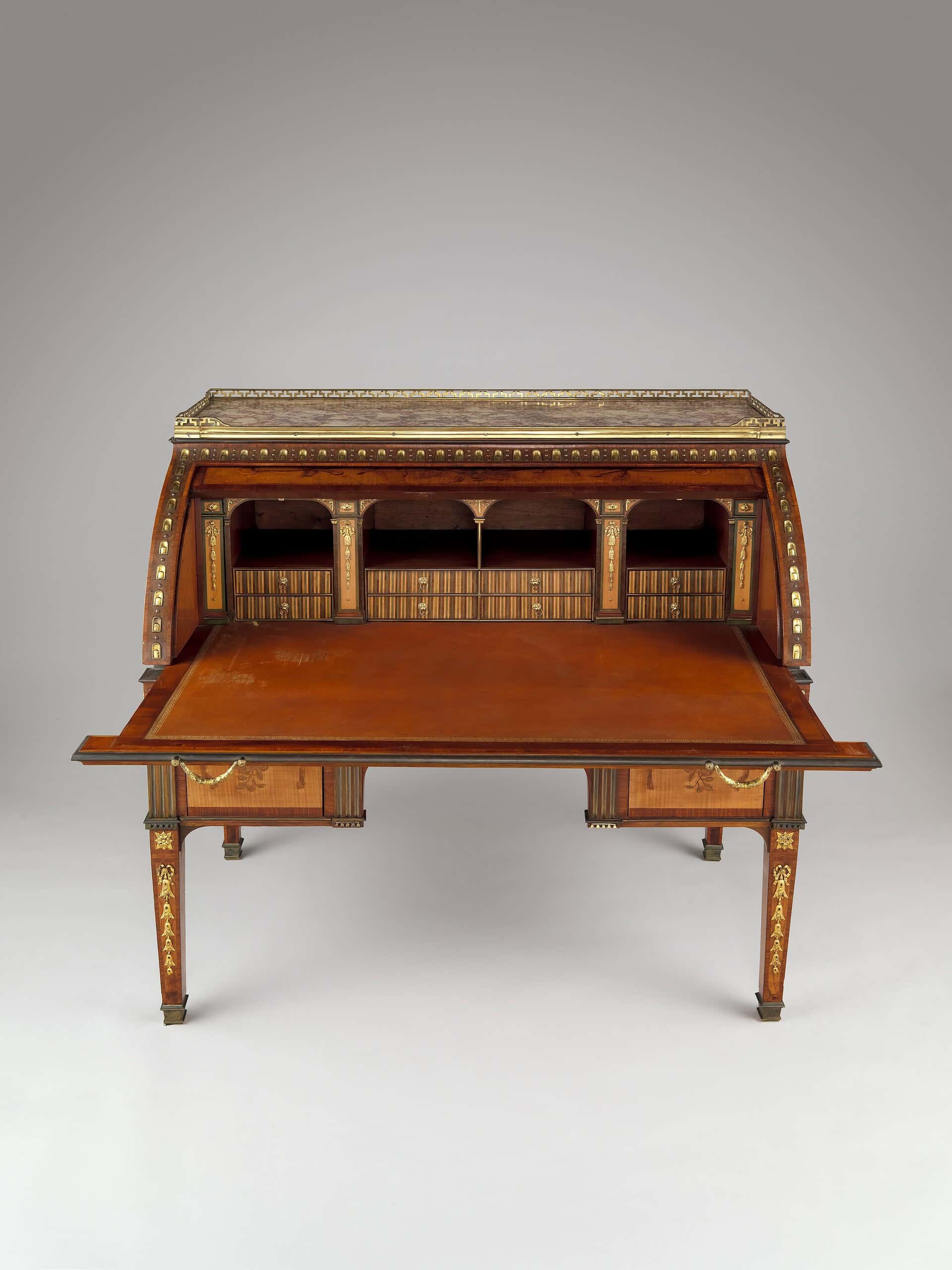 A cylinder desk with floral marquetry, shown open: the cylinder slides back into the body, revealing an architectural interior of pigeonholes and drawers, while a pull-out, leather-covered slope enlarges the writing surface. This is exactly what made the eighteenth-century secretary a “technology of privacy”: in a house full of servants with keys to everything, the piece offered a space that truly locked. Licence: David Roentgen, cylinder desk (open view), Neuwied, c. 1780. The Metropolitan Museum of Art, New York (inv. no. 58.75.55, public domain).
David’s strategy for winning these clients was audacious to the point of impudence: he did not wait for orders but sent finished masterpieces to the courts he had picked out in advance. His first serious target was Charles Alexander of Lorraine, governor of the Austrian Netherlands and a collector with an appetite today’s auction houses would not be ashamed of. But the real contest waited in Paris — on the hardest market in Europe, where outsiders were shielded from the local guild by nothing but cunning and patronage.
In the winter of 1778–79 David staked everything on a single card: he brought to Paris a monumental secretary cabinet built without an order, purely on speculation, and for three months waited in suspense on the court’s decision. In March 1779 Louis XVI bought the piece for 80,000 livres — the highest sum the French royal house ever paid, before or since, for a single piece of furniture — and had it placed in his cabinet. One accounting detail is telling: the purchase was made not by the office that managed the royal furnishings but from the monarch’s privy purse. It was not the French state that bought itself a piece of furniture; it was Louis who bought himself a toy. Equally characteristic is what followed: David saw to it that news of the transaction and its price went round the French and German press. The price ceased to be a trade secret and became advertising — a mechanism we would today call building a brand through a record.
Paris repaid him in its own coin: the joiners’ guild forced the newcomer from the Rhineland to enrol formally in its ranks, so that from 1780 David figured as a Paris master — he who owed his whole life to the fact that in Neuwied he had had no guild over him at all. More and more now bound him to the court: Marie Antoinette conferred on him the title ébéniste mécanicien, and judged his secretary a gift worthy of a pope — a Neuwied piece travelled in her name to Pius VI. The dulcimer automaton that reached Versailles in 1784 has already been mentioned; in the same period courts from Brussels to Naples were paying for the mechanical marvels of Neuwied.
 The Berlin “Neuwieder Kabinett” — the most elaborate of the workshop’s three monumental secretary cabinets, an architectural body crowned with a domed clock. Built on speculation, without an order, it went in 1779 to the Prussian heir to the throne, securing Roentgen the patronage of the future Frederick William II. The gilt bronzes were supplied by the Paris master François Rémond. Licence: David Roentgen, “Neuwieder Kabinett” secretary cabinet, Neuwied, 1778–79 and 1786. Kunstgewerbemuseum, Staatliche Museen zu Berlin. Photo Sailko, CC BY 3.0.
The most enduring alliance, though, bound David to Berlin. Frederick William II, owner of the Berlin secretary already mentioned, favoured the cabinetmaker in ways that went far beyond purchases: in 1791 he conferred on him the title of Royal Prussian Privy Councillor. Contemporaries could not believe their ears. “And so a joiner is styled: Herr Privy Councillor! This is surely the only case in the history of the world of a joiner sitting as a privy councillor” — recorded Baron von Wackerbarth in an account of a journey to the Rhine in the autumn of 1791 (quoted after Koeppe 2012; translation the present author’s). A year later the king, with his whole retinue, paid his “diplomatic agent on the lower Rhine” an official visit: he inspected the community’s choir houses and then sat down to dinner in the Roentgens’ house. The direction of delivery was reversed: for thirty years the furniture of Neuwied had travelled to palaces — now the palace had come to the cabinetmaker.
A DESK FOR THE EMPRESS
In the autumn of 1783 a letter from Paris reached St Petersburg. Baron Friedrich Melchior von Grimm — a diplomat in retirement, an arbiter of taste and Catherine II’s most trusted Paris correspondent — commended to the tsarina a certain traveller then making his way to the Neva:
“May I be permitted to report a man who is at this very moment on his way to St Petersburg? It is Herr Roentgen, the famous Herrnhuter, beyond doubt the best cabinetmaker of this century. He comes because the finest minds attract one another: since Your Majesty cannot go to Neuwied on the Rhine, the celebrated Roentgen makes his way to St Petersburg on the Neva. Neuwied is the theatre of his glory, as the universe is the theatre of Catherine II. France, Germany and Holland ring with his fame. […] Should Your Majesty not want the piece, he will take it back to Neuwied and, as a good Herrnhuter, seek consolation in Christ, who is dear to him.”
M. von Grimm to Catherine II, 1783; quoted after H. Huth, Roentgen Furniture, 1974; translation the present author’s
This was not how one wrote of craftsmen; it was how ambassadors were announced. And the last sentence of the letter — after all that had passed between David and his community — held more irony than Grimm could have supposed.
The letter did not hang in a vacuum: it was part of a prepared campaign. In the winter David set out eastward — from Berlin to St Petersburg there still lay twelve hundred and fifty miles and six weeks of road ahead of him — carrying a piece built specially for a single client. And “for a single client” is to be taken literally: before the expedition, careful intelligence was gathered on the empress’s taste. Catherine liked to be praised as a patroness of the sciences and arts — so a figure of Apollo crowned the great desk. Catherine loved her greyhounds — so the handle that opened the hidden compartments was given the form of Zémire, her favourite little bitch. It would be hard to find a purer example of what is now called the personalisation of luxury; in the eighteenth century it had as yet no name at all, for no one before Roentgen had done it with such premeditation.
The calculation proved right, and more. The empress paid the 20,000 roubles asked — a sum comparable to the price of a landed estate — and then added, of her own accord, a gold snuffbox and a bonus of 5,000 roubles. In an age when craftsmen dunned aristocrats for years over unpaid fees, the monarch paid more than was asked of her, and did so publicly: the news, carried by Grimm’s correspondence network, went round Europe faster than many a diplomatic dispatch. Both sides got what they were after. David — a market. Catherine — one more proof that in St Petersburg, sooner or later, one pays like a tsar.
Sooner or later — for it also happened that it was later. The dealings with St Petersburg were not one unbroken run of generosity: in a letter of 22 June 1789 Roentgen politely, in French, reminded the empress of 26,000 roubles outstanding for three cabinets delivered to the Hermitage sixteen months earlier — pieces with a hundred drawers each, designed to hold her celebrated collection of cameos. Even the most powerful client in Europe could keep one waiting.
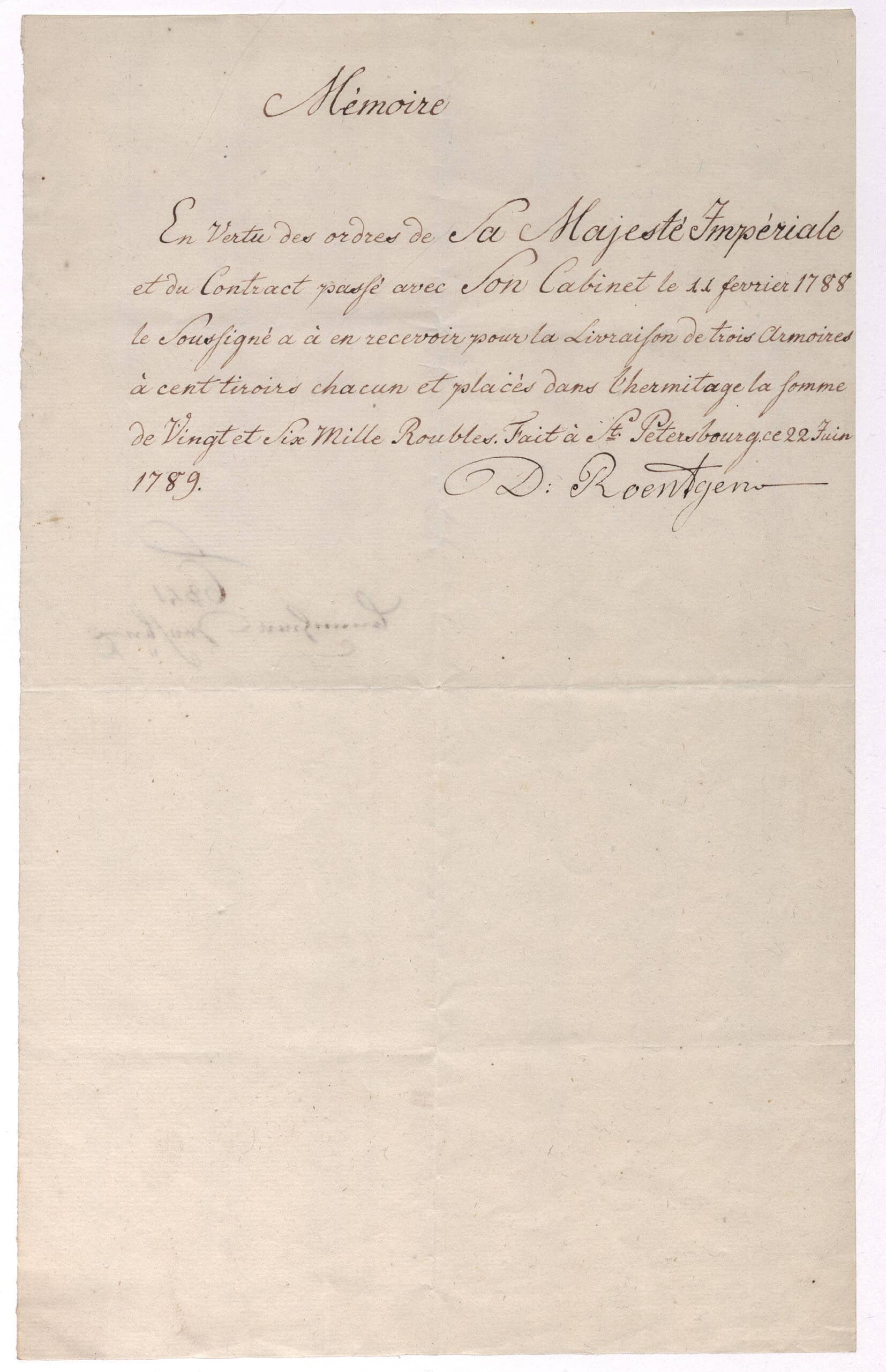 David Roentgen’s letter to Catherine II of 22 June 1789 — a polite reminder about 26,000 roubles for three cabinets delivered to the Hermitage sixteen months earlier. Each had a hundred drawers and held the empress’s famous collection of cameos. Written in French, the language of the courts of the day, the document shows the other, less luminous side of trade with crowned clients. Licence: David Roentgen, letter to Catherine II, 22 June 1789. Thomas J. Watson Library, The Metropolitan Museum of Art (MS 44, folder 7; public domain).
The effects were immediate: the Russian aristocracy began to order “Neuwied furniture” by the dozen, as though it were dinner services of porcelain. David travelled to St Petersburg several more times, and a single delivery of March 1786 ran to a hundred and twenty-six pieces valued together at 72,704 roubles. The logistics of these transports — crates floating from the Rhine through Hamburg and the Baltic, or trundling along the highways through Berlin to the east — were an undertaking in themselves; and it is worth remembering that some of those highways ran through lands Russia and Prussia had just taken from the Polish–Lithuanian Commonwealth. Poland, as it happens, appears in this story once more, in a role it never came to play: when the workshop weighed relocation at various moments — to London, Berlin, Kassel — the directions under consideration included, as scholars note, “even Poland.” Nothing came of the plans; had it been otherwise, this essay might have been telling of a manufactory outside Warsaw.
At the St Petersburg court the furniture of Neuwied settled in for good — to this day one of the largest ensembles of Roentgens can be seen in the Hermitage. But in the year when Catherine was paying David a bonus for perfection, only a few years remained of the old world.
THE END OF THE OLD WORLD
The Neuwied business model had one weakness, invisible so long as the world stood in its place: the entire clientele belonged to a single class. When, in 1789, that class began to lose first its fortunes and then its heads, the workshop had nowhere to fall back to. The market for the highest luxury did not shrink — it vanished.
From here events move to the rhythm of war communiqués. In 1793 the fabrique had to be cut back, because the army was taking the craftsmen. David’s Paris depot, his largest shop window, the revolutionary government treated by a simple logic: the owner does not live in France, therefore he is an émigré, and an émigré’s property is subject to confiscation. In October 1794 revolutionary troops stood before Neuwied itself; a year later they crossed the Rhine. What could be saved from the stores David evacuated deep into Germany, to Kassel and Gotha — furniture designed for palace cabinets now travelling in crates ahead of the front.
In that same year, 1793, at the start of March, Abraham died. He spent his last years where everything had begun — in Herrnhut, at the mother community — and there he was buried. There is a symmetry in the father’s life the son could no longer repeat: Abraham managed to return to the point of departure before the point of departure ceased to exist.
A box with hidden drawers and mechanisms, the work of Heinrich Gambs — a journeyman who trained under Roentgen and accompanied him on the journey to Russia in 1790. After the Neuwied workshop closed, Gambs settled in St Petersburg and for decades built secret-keeping furniture there in his master’s style, winning clients as high as the future Empress Maria Feodorovna (wife of Tsar Paul I). Roentgen’s firm did not survive the Revolution — but his school scattered across Europe and carried on. File / licence: Heinrich Gambs, mechanical box, 1800–1810. The Metropolitan Museum of Art, New York (public domain).


David closed the manufactory’s books in 1801. The people dispersed across Europe — and that dispersal proved, paradoxically, the last act of expansion. Craftsmen trained in Neuwied carried its standards into workshops of their own; Heinrich Gambs, who had come up under Roentgen’s hand, became for the following decades the foremost furniture maker of St Petersburg. The firm died; the school did not.
David himself spent his last years in the role he had worked towards all his life, though he never named it: that of diplomat. Now without fees. He conducted wide-ranging charitable work, shepherded the Brethren through the upheavals of war, and sat on the community’s supervisory board — the same community that forty years earlier had judged him the evil spirit of the family (as chairman, let it be noted, he was never elected). In February 1807 he travelled to Wiesbaden to negotiate with the new sovereign, the Prince of Nassau, over the maintenance of the Herrnhuters’ privileges after the annexation of the county of Wied. He died in the course of those negotiations, on 12 February, after a few days’ illness — sudden enough that his son demanded an autopsy, a thing unheard of among the Moravian Brethren, for the fear of poisoning by rivals seemed to no one absurd. The autopsy most likely showed lung cancer. His second son, August, finished the talks at his father’s deathbed; the prince confirmed the community’s rights.
The man his community had expelled for saving the firm died saving the community.
LESSONS FROM NEUWIED
A hundred years after David Roentgen’s death, the fiercest enemy of ornament that architecture ever produced confessed a thing that seems, on the face of it, absurd. Adolf Loos — author of the manifesto “Ornament and Crime,” the man who held decoration to be a crime against culture — said: “David Roentgen was the idol of my whole life. […] What must have impressed the empress was the incredibly high quality of the workmanship of that desk” (quoted after Huth 1974; translation the present author’s). The confession is a paradox only in appearance. What Loos admired in the furniture of Neuwied was not the ornament; it was what lay beneath it — precision of execution carried to the limits at which style ceases to matter. And this is the first of Roentgen’s lessons for anyone furnishing an interior today: quality of workmanship is a value independent of style. Fashions in marquetry come and go; a drawer that after two hundred and forty years still slides out without a sound never goes out of fashion.
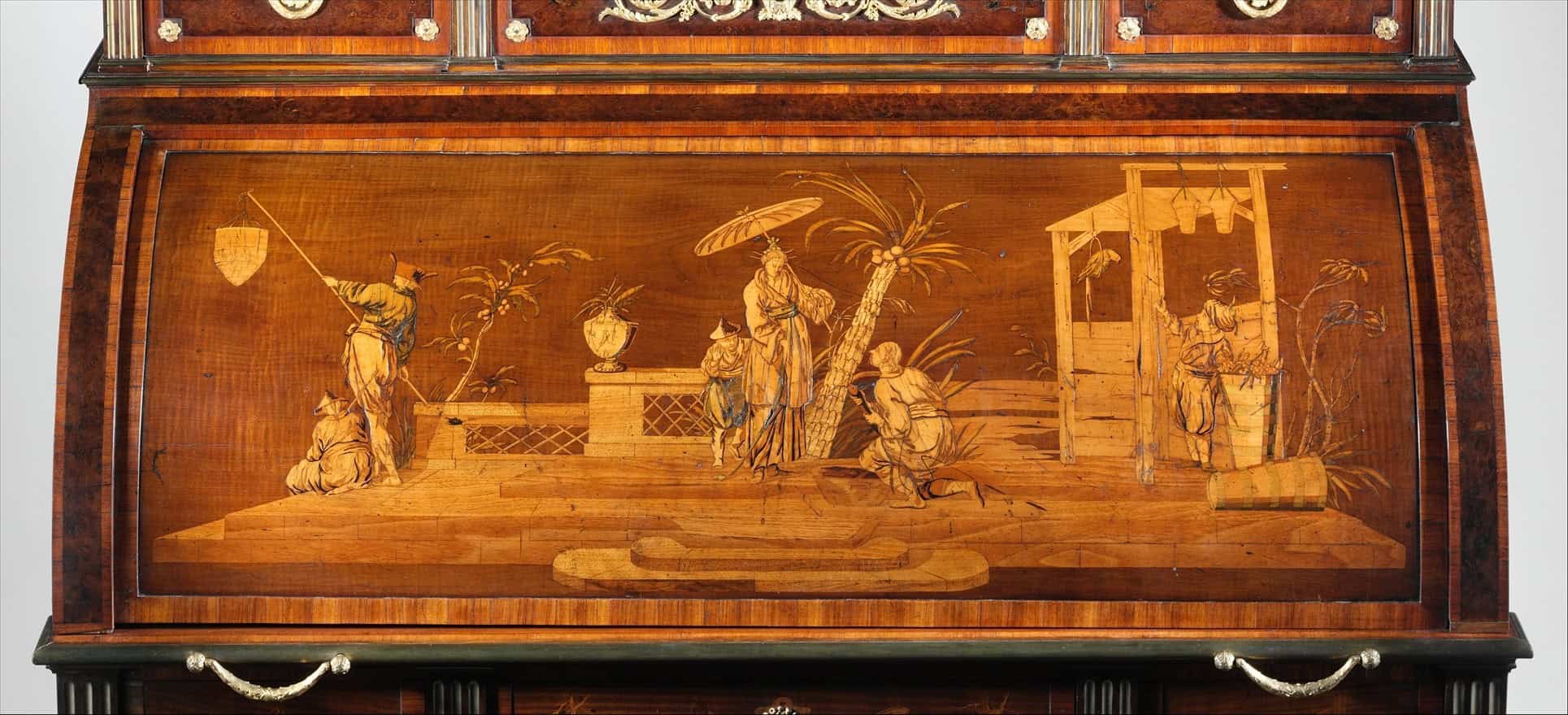
A fragment of marquetry from the desk shown earlier, in close-up. What from a distance looks like a painted picture — a chinoiserie scene with several figures — was in reality assembled from hundreds of pieces of naturally coloured wood, matched grain to grain, after a drawing by the painter Januarius Zick. It was precisely this quality of workmanship, not the ornament itself, that Adolf Loos admired in Roentgen. Licence: detail of chinoiserie marquetry, cylinder desk by David Roentgen, c. 1776–1779. The Metropolitan Museum of Art, New York (inv. no. 41.82, public domain).
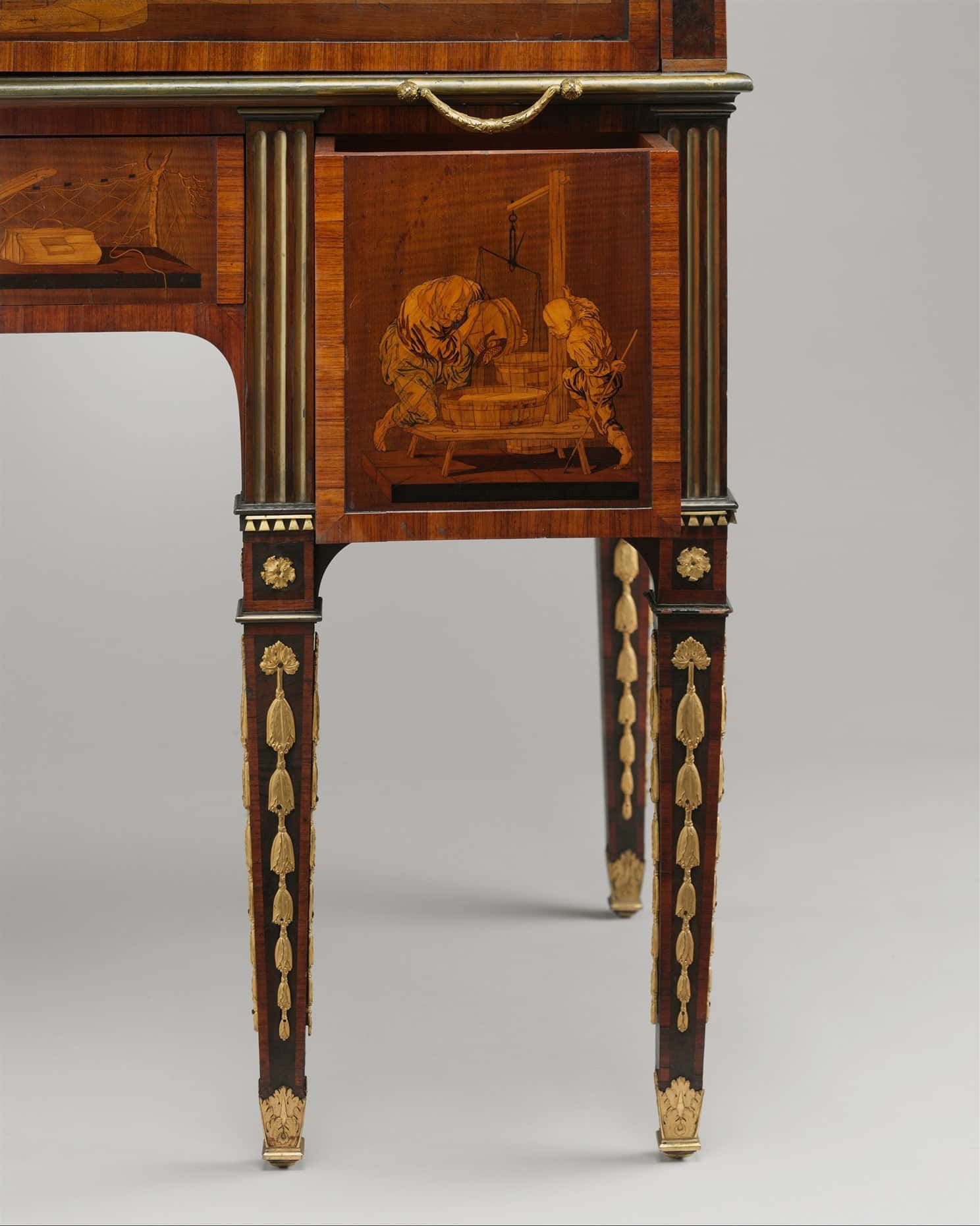
The second lesson concerns multi-functionality. Roentgen’s furniture — tables that are at once reading slopes, easels and games tables; secretaries that hold, in a single body, a chancery, a treasury and a musical instrument — was made for people who were moving their lives from ceremonial halls into small private rooms and needed more than one function from a single object. It sounds familiar: this is exactly the problem of the modern dwelling, in which the living room doubles as a study and the bedroom as an office. The eighteenth-century answer remains valid in its essence: transformation need not be a compromise. A piece that does three things can do each of them well — provided someone has really thought it through.
The third lesson is concealed storage. The commercial secret of Neuwied came down, in the end, to one thing: complexity hidden beneath a calm surface. A closed Roentgen secretary is a smooth, composed body; the whole machinery begins only once the key is turned. Modern design has arrived at the same principle from the other side — clean planes behind which the complexity of daily life disappears — and it is worth knowing that this ideal has an eighteenth-century pedigree.
The fourth lesson is about luxury. Catherine II did not pay a bonus for a desk; she paid for the fact that someone knew her dog’s name. Personalisation — today declined in every case — was for Roentgen the essence of the product: a shared structural base, and on it a configuration cut to a single person, their habits, vanities and secrets. This is still the shortest definition of bespoke design we have.
There is, finally, a last lesson, the least obvious. The Neuwied manufactory divided its work among two hundred specialists not in order to produce more cheaply but in order to produce better — the reverse of the factories that came after it. In an age of general talk about fast furniture, this eighteenth-century model — craft organised at scale but subordinated to quality — sounds less like a curiosity and more like a proposal.
The tension with which this essay began — between restraint and splendour, discipline and imagination — was never resolved at Neuwied. It was built into the furniture. Perhaps that is why the pieces still work today.
WHERE TO SEE THE ROENTGENS
- The Metropolitan Museum of Art, New York — a dozen or so objects by Abraham and David, excellent online object pages and films showing the mechanisms in motion.
- Kunstgewerbemuseum, Berlin — the Berlin secretary, the workshop’s opus magnum.
- The Hermitage, St Petersburg — one of the largest ensembles of Roentgen furniture, a legacy of Catherine II’s purchases.
- Musée des arts et métiers, Paris — Marie Antoinette’s dulcimer automaton, still in working order.
- Roentgen-Museum, Neuwied — a museum devoted to the workshop and to the Kinzings’ clocks, in the town where it all began.
- Designmuseum Danmark, Copenhagen — the desk from the 1769 Hamburg lottery, the chief prize.
- MAK, Vienna — one of the three twin “Neuwieder Kabinett” cabinets.
- Rijksmuseum, Amsterdam — furniture by Abraham Roentgen.
BIBLIOGRAPHY
Primary works
- Koeppe, Wolfram (ed.), Extravagant Inventions: The Princely Furniture of the Roentgens, exhibition catalogue, The Metropolitan Museum of Art / Yale University Press, New York 2012. — The contemporary point of reference for the whole subject: essays on the community (B. Willscheid), the courts (R. Baarsen, B. Rondot, A. Stiegel) and Russia (T. Rappe), with appendices on the mechanisms and the marquetry. The full text is available free on Met Publications (metmuseum.org).
- Huth, Hans, Roentgen Furniture: Abraham and David Roentgen, European Cabinet-Makers, Sotheby Parke Bernet, London–New York 1974. — The classic English-language monograph; includes a catalogue, a list of the workshop’s employees and transcriptions of source documents, among them Grimm’s letter to Catherine II quoted in this text.
Further reading
- Fabian, Dietrich, Abraham und David Roentgen: Das noch aufgefundene Gesamtwerk ihrer Möbel- und Uhrenkunst in Verbindung mit der Uhrmacherfamilie Kinzing in Neuwied, Bad Neustadt an der Saale 1996. — The fullest documentation of the works; the German reference catalogue.
- Fabian, Dietrich, Kinzing und Roentgen: Uhren aus Neuwied, Bad Neustadt an der Saale 1984. — A separate study of the clocks and the collaboration with the Kinzing family.
- Greber, Josef Maria, Abraham und David Roentgen: Möbel für Europa, vols 1–2, Josef Keller Verlag, Starnberg 1980. — An older standard monograph, still cited.
- Stürmer, Michael, Handwerk und höfische Kultur: Europäische Möbelkunst im 18. Jahrhundert, C. H. Beck, Munich 1982. — The economic and social background of court furniture in the eighteenth century; the source of the reading of the Roentgen manufactory as a “guild-free” luxury enterprise.
- Willscheid, Bernd (ed.), Edle Möbel für höchste Kreise: Roentgens Meisterwerke für Europas Höfe, exhibition catalogue, Roentgen-Museum Neuwied, Neuwied 2007.
- Thillmann, Wolfgang, and Willscheid, Bernd (eds), MöbelDesign: Roentgen, Thonet und die Moderne, Roentgen-Museum Neuwied, Neuwied 2011. — The one title that traces the line from Roentgen through Thonet to the modern; the closest to the design perspective of this text.
- The current collection catalogue of the Roentgen-Museum Neuwied (2022) — Roentgen and Kinzing furniture and clocks in the museum’s collection.
Sources and online resources
- Koeppe, Wolfram, “Abraham and David Roentgen,” in Heilbrunn Timeline of Art History, The Metropolitan Museum of Art, metmuseum.org. — A concise survey essay with links to objects.
- The David Roentgen Papers, Thomas J. Watson Library, The Metropolitan Museum of Art (digitised collection). — Correspondence and documents of the Roentgen family, including receipts for Catherine II’s payments.
- The Roentgens’ Berlin Secretary Cabinet, film, The Metropolitan Museum of Art, YouTube 2012. — The demonstration of the Berlin secretary’s mechanisms set at the opening of this text.
- Object pages: The Metropolitan Museum of Art (Open Access), Rijksmuseum, Musée des arts et métiers, Kunstgewerbemuseum / Staatliche Museen zu Berlin.