How Shaker Furniture Became a Style
The earliest accounts of the Shakers say nothing about furniture. They speak of bodies — bodies that could not be kept still. Worshippers shook, cried out, sang and spun until they collapsed exhausted on the floor.
Two and a half centuries later, the same word sells kitchens.
Before “Shaker” became the name of a style, it was a taunt. “Shaking Quakers” was the nickname given to a small group born out of the ferment of eighteenth-century Protestantism, where Quaker austerity met prophets who had fled France, bringing with them a gift for sacred convulsions and the stubborn conviction that God had not stopped revealing himself to humankind when the last Apostle died.
Ann Lee, the daughter of a Manchester blacksmith and herself a factory worker, joined the group around 1758. Illiterate, and the mother of four children who had all died in infancy, she concluded that sexual intercourse was the source of all sin. In time, she rose from prophet to leader and, in the community’s mature theology, to the female embodiment of Christ at his Second Coming. In 1774, she sailed for America with eight followers.
The new faith promised a life without sin. In practice, this meant celibacy, confession, absolute obedience, the abolition of private property and a daily existence regulated almost by the hour. The rule reached far beyond the soul: it determined which staircase one might use, on which side of the house one might sleep and how many drawers the house should contain.
At first, worship was violent and unpredictable; the body was expected to submit to the Spirit. Yet even ecstasy could be trained. In time, the whirling crowd arranged itself into orderly ranks — women apart from men — moving forwards and backwards and turning at the appointed beat. Inspiration did not disappear. It acquired choreography.[1]
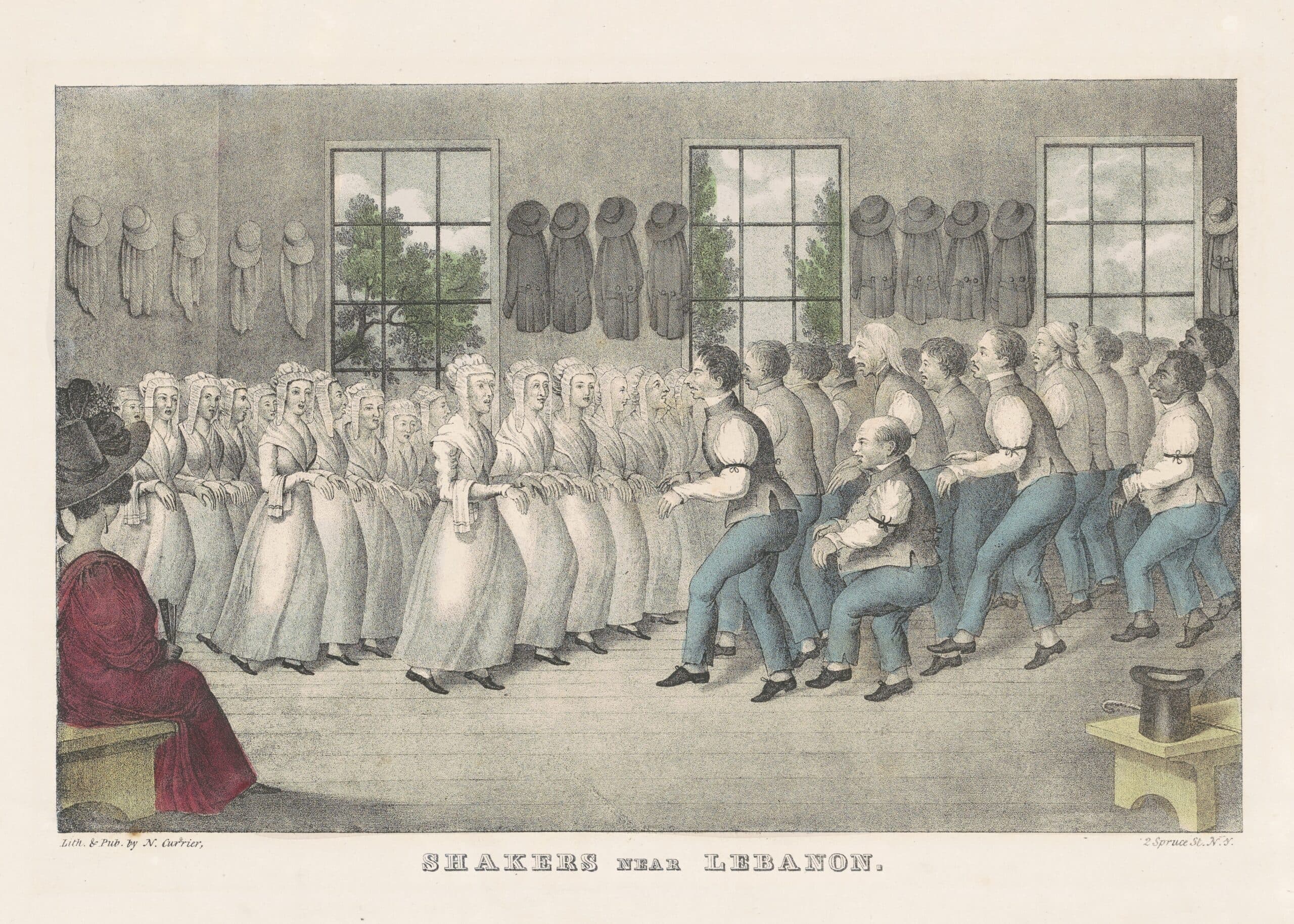 Nathaniel Currier, Shakers Near Lebanon, c. 1838–1857. Women and men move in separate ranks according to a prescribed formation. The ecstatic practices from which the community took its name gradually assumed the form of precise choreography. Lithograph, public domain.
Ann Lee died in 1784 — without an heir by blood, which is hardly surprising in a religion without descendants. The movement, born of an uncontrolled touch of the Spirit, now had to prove something harder than ecstasy: that it could survive the morning after. It did. Under Joseph Meacham and Lucy Wright, within a single generation the community of convulsions acquired a hierarchy, a body of law, an economic system and a daily schedule divided into quarter-hour intervals. The Spirit got an organisational chart.
Prayer, work, meals, dress and the very manner of moving through the house were all subjected to regulation. For the Shakers, the arrangement of rooms, places of storage and routes through the building were not a neutral backdrop to life — they were instruments for governing it. Keeping a hundred people celibate is easier when the architecture itself makes sure they do not run into one another on the stairs.
They lived in groups known as families — a bold term for a community in which kinship, and everything that might lead to it, was forbidden. A family might consist of anything from a dozen to a hundred people. In the larger houses, women and men had separate bedrooms and occupied separate parts of the building; depending on the settlement, they might also have their own entrances, staircases, broad corridors or entire wings. Architecture allowed them to live together without ever letting them forget that they lived apart.[2]
Utopia Needs Drawers
The abolition of private property did not reduce the number of things. There were just as many clothes, books, tools, dishes and brushes as before — except that in a house shared by several dozen people, the question “Whose is this?” ceased to matter, while “Where should it go?” became a matter of public concern.
Walls were therefore filled with cupboards, counters and entire ranks of drawers. Clothes were marked with initials, bedlinen assigned to a family, tools arranged so that anyone could find them and return them to their proper place. Renouncing possessions, it turned out, did not liberate anyone from things. It merely turned the owner into an administrator.
Edward and Faith Andrews counted 860 built-in drawers in the Church Family dwelling at Enfield — around nine for every inhabitant in the mid-nineteenth century.[3] The number is impressive, but it does not testify to a love of drawers. It reveals the scale of the experiment: when everything is held in common, every object needs a place intelligible to everyone, not merely to its owner — because there is no owner. Utopia needed drawers not to conceal an excess of things, but to make communal life possible at all.
 Built-in banks of drawers in the Church Family dwelling at Hancock. Storage was not confined to freestanding furniture: cupboards and drawers occupied recesses, corridors, attics and the spaces beneath staircases. Photograph by Elmer R. Pearson, 1970, Historic American Buildings Survey, Library of Congress, public domain.
The peg rails running along the walls followed the same logic. Clothes, mirrors, tools and brushes were hung from them, as were lightweight chairs during cleaning. A room could thus be cleared within minutes and prepared for work, a meal, prayer or dancing. What is now photographed as an austere composition and offered in catalogues as “inspiration” was simply a clever way of making the floor easier to wash. The slenderness and lightness of these interiors were not an aesthetic programme. They were the by-product of a way of life in which furniture had to move aside. Modernism discovered a manifesto in it only later. At the time, the point was to keep everything out of the mop’s way.
 Chairs suspended from a peg rail at Hancock Shaker Village. The rail allowed clothes, tools and lightweight furniture to be lifted clear of the floor. What now resembles a minimalist composition belonged above all to the logistics of domestic life. Photograph by Richard Taylor, 2008, CC BY 2.0.
Once the Drawer Is Out
The most interesting thing about one particular drawer from Enfield cannot be seen until the drawer is removed. Its sides are thin at the top and thicken towards the bottom — probably to reduce weight without weakening the lower edge, which runs along the guide and wears fastest. It is an ingenious and laborious solution: the board first had to be tapered, then dovetail joints cut into material of varying thickness. Wood and weight were saved — not the joiner’s time.[4]
It is a small detail, but it overturns a favourite legend about Shaker form: that it arose through the consistent removal of everything unnecessary. Sometimes the opposite was true. More labour could be required to make an object look as though it had been produced by taking labour away. Simplicity had its price.
The same applies to table legs. A square block at the apron gave way to a turned cylinder, tapering towards the floor — not as ornament, but as an elaboration of the construction itself, which happened to lend the furniture a certain slenderness. In the twentieth century, this was presented as proof that beauty appears of its own accord once decoration is removed. The conclusion suited modernist theory, though not necessarily the intentions of the nineteenth-century maker, whom nobody consulted because he was long dead and unable to object.
A restraint in ornament did not, in any case, amount to aesthetic indifference. Shaker furniture includes asymmetrical arrangements of drawers, bevelled frames, moulded edges, carefully turned elements and surfaces painted with no particular restraint at all. How much of this was permitted depended on the settlement, the period, the object’s purpose and the skill of the joiner — not on a single rule of purity.
The chairs became the most famous: turned posts, horizontal back slats, a woven seat. Yet there was never any single thing called “the Shaker chair”. They made low dining chairs and high chairs for working at tailors’ counters, revolving stools, rocking chairs, children’s chairs, furniture for the sick and elderly, and devices to assist walking. The differences were not stylistic whims; they arose from particular bodies, tasks and rooms. Only once those bodies and tasks had been removed could all this variety be reduced to a few shared traits: the slender post, the rung, the woven seat. Style was what remained of the chair once the person meant to sit on it had been taken away.
The chairs had been sold outside the communities since the late eighteenth century, eventually on a scale that had little in common with spiritual asceticism. In 1872, the South Family at Mount Lebanon built a steam-powered factory. It employed around ten people and was designed to produce two dozen chairs a day; numbered models, standardisation, catalogues, a network of buyers and hired workers from outside the community followed.[5] The same community that hung chairs from pegs to wash the floor also ran serial production beneath a factory chimney.
 Eldress Sarah Collins weaves a chair seat (“Filling Chair Orders”), Mount Lebanon, New York, postcard, early twentieth century. Chairs made for sale were produced by identifiable people — in this branch of the work, most often women — rather than by the anonymous craftsman of later legend. Hamilton College Communal Societies Collection.
There was no contradiction in this. A machine that saved effort and produced repeatable results fitted the Shaker cult of labour as comfortably as a well-sharpened chisel. The contradiction emerged only in the story told afterwards. A steam-powered factory looked dreadful in a history of spirituality, simplicity and the direct bond between hand and wood, so the story simply cropped it out, just as later photographs cropped out objects that spoiled the composition. A solitary craftsman was left at his bench. The chimney did not fit.
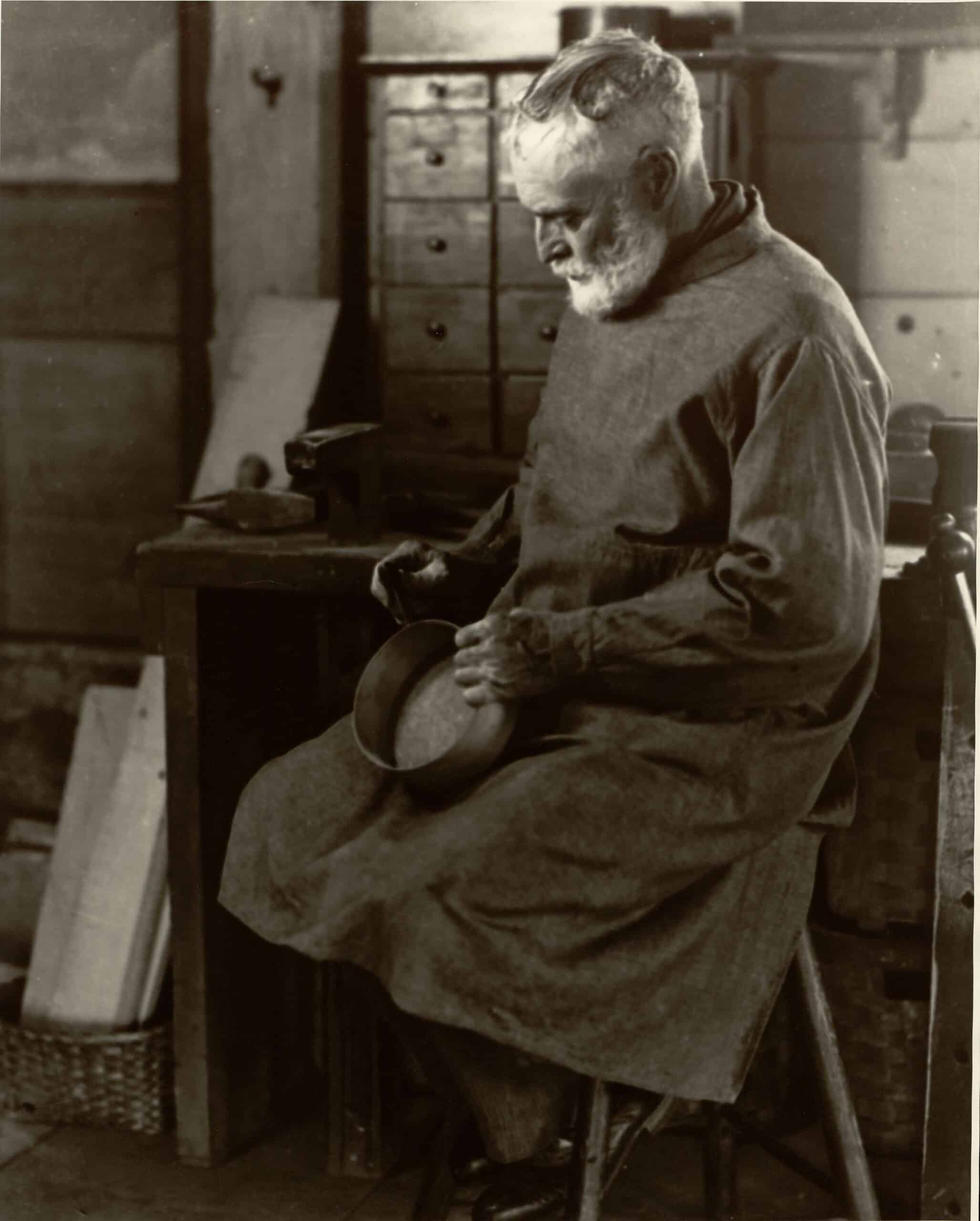 Brother Ricardo Belden makes an oval box in the workshop at Hancock Shaker Village, 1935. Handwork did not disappear with the mechanisation of production, although later legend was happy to present it as the entirety of the Shaker economy. Photograph by Samuel Kravitt, public domain.
A great many other things did not fit either. The communities bought raw materials and ready-made components, hired outsiders and sold goods far beyond their own settlements. Self-sufficiency was a noble ideal, not a description of what happened in practice.
The popularity of the chairs attracted imitators, whereupon something almost too amusing occurred. In catalogues from the 1870s, the makers at Mount Lebanon warned against imitations sold as Shaker and — to distinguish their wares from the copies — introduced a trademark. A community that had abolished private property had no difficulty grasping the concept of brand ownership.
 Seed boxes bearing the inscriptions “Shakers’ Choice Vegetable Seeds”, “Shaker Seed Co., Mount Lebanon” and “Shakers’ Seeds for 1874”. The community sold seeds far beyond its own settlements and marked its goods with a name and place of origin long before “Shaker” became the name of a style. Photograph by U.S. Army (familymwr), Flickr / Wikimedia Commons, CC BY 2.0.
 Cover of Illustrated Catalogue and Price List of Shakers’ Chairs, R. M. Wagan & Co., Mount Lebanon, c. 1880, bearing the trademark notice: “The above Trade-Mark will be attached to every genuine Shaker Chair, and none others are of our make”. A community that had abolished private property branded its product in order to distinguish it from imitations. Hancock Shaker Village collections, Pittsfield, accession no. 1962.643; public domain due to age.
Thus, even in the nineteenth century, the word Shaker began to denote not so much the place in which a piece of furniture had been made as a particular kind of commodity and the quality associated with it. Once a name can be transferred from a specific maker to a type of product, the route from the community’s wares to an autonomous “style” lies open.
The Green Bed Was Orange
The collection at Hancock Shaker Village includes a bed that looks exactly as a typically Shaker object is expected to look: simple, restrained, painted a soothing, muted green. Analysis of the finish spoiled the picture. The green proved to be later; deeper down, lodged in the grain of the wood, was the first layer — a strident orange.
The history of Shaker colour begins, then, not on the surface but beneath it. And it looks rather different from what the surface would have us believe.
The conservator Susan L. Buck examined finishes from Mount Lebanon, Canterbury, Hancock and Enfield: layer cross-sections, pigments and binding media, all compared with surviving recipes. Beneath later repainting she found reds made from ochre and red lead, chrome yellows, Prussian blue, greens, oranges and salmon tones — not on minor objects, but on cupboards, built-in fittings, chests, doors and mouldings. Interiors that later generations imagined as bare timber and white were, in reality, often bright and multicoloured.
Later, these colours were explained with stories that nobody took much trouble to verify. They corresponded to the colours of the heavens. Dark blue was ground from berries and buttermilk. Auction catalogues persisted in describing surfaces as retaining their “original milk paint”, because buyers are happier to pay for something domestic and innocent than for something industrial.
The chemistry was less charming. Blue was made from Prussian blue and lead white, usually in an oil binder — in other words, from lead paint, the same material used to paint half the world. The idyllic buttermilk can be dismissed for quite prosaic reasons: the strongly alkaline environment of casein paint would have turned Prussian blue brown, so milk simply could not have been present on these surfaces. Even the beguiling celestial blue found in recipes need not refer to the heavens; it also functioned as an ordinary commercial colour name.[6]
Rosetta Hendrickson’s surviving notebook lists lead white, vermilion, verdigris, ochre, chrome yellows, Prussian blue, linseed oil, turpentine, shellac and varnishes — and some of the recipes were copied almost word for word from popular English and American manuals. The community that separated itself from the world with a wall of doctrine mixed its paint according to the same instructions as the world on the other side. Spiritual separateness did not extend to the pigment department.
This does not mean that they painted carelessly. The wood was sized to reduce absorption, thin coats of oil paint were applied, tops and handles were protected with varnish, and tinted glazes deepened the colour while protecting the surface. Neither a miraculously natural technique from outside history nor crude daubing with whatever lay to hand — just sound, competent workmanship. The difficulty is that “sound, competent workmanship” does not sell as well in a catalogue as “paint made from berries”.
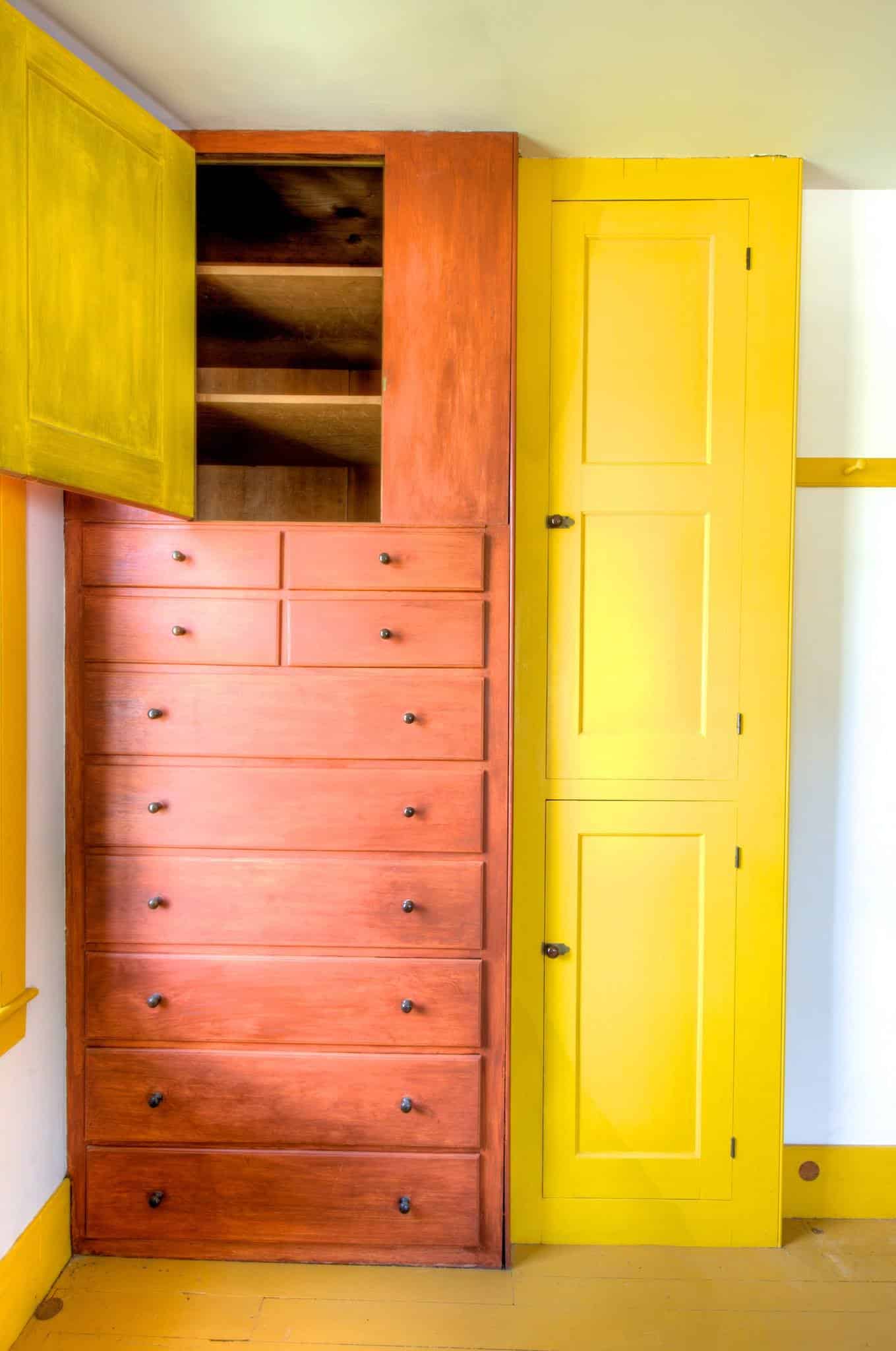 Painted built-in fittings in the Brick Dwelling at Hancock Shaker Village. The intense yellows, reds and greens depart sharply from the later image of Shaker interiors as a world of natural timber and muted colour. A contemporary photograph of the present display; the historical palette is documented by conservation research. Photograph by Bestbudbrian, 2016, CC BY-SA 4.0.
A question more difficult than pigment remains: which layer should be considered the true one? The Shaker mania for cleanliness was not kind to objects later treated as historic — furniture was washed, scraped and repainted, and recipes even survive for stripping old finishes with lye. At Canterbury, bright yellow woodwork dating from 1837 was stripped clean and painted white; as with the bed, the earlier colour survived only where it could not be reached, deep in the grain. Some of these changes were made by later owners, schools, dealers and conservators. Others were made by the Shakers themselves, who never imagined that the first layer of paint was a document intended for a future museum.
So let us return to the bed. Its orange and green surfaces are not falsehood and truth, but two moments in a single life: the moment of its making and the moment when taste changed. The trouble is that restoring one means erasing the other. The authenticity everyone craves does not reside in either layer alone — it has to be chosen. And the layer chosen is usually the one that confirms what we wanted to see in the first place.
How the Past Is Furnished
In 1930, William F. Winter photographed Sister Anna Case’s room at Watervliet. Pictures and photographs hung on the walls; patterned carpets covered the floor; among them stood an ornamental stove, a bed with turned finials and furniture from several periods. The interior was entirely Shaker. It had only one defect: it looked nothing like what was shortly to be accepted as Shaker.
In other photographs by Winter, the same interiors look quite the opposite. Pale walls, almost empty floors, individual pieces of furniture set far apart, each like an exhibit beneath its own spotlight. Such a composition allowed the construction and proportions of an object to be studied — while cutting it off from clutter, from history and from the fact that somebody had once used it.

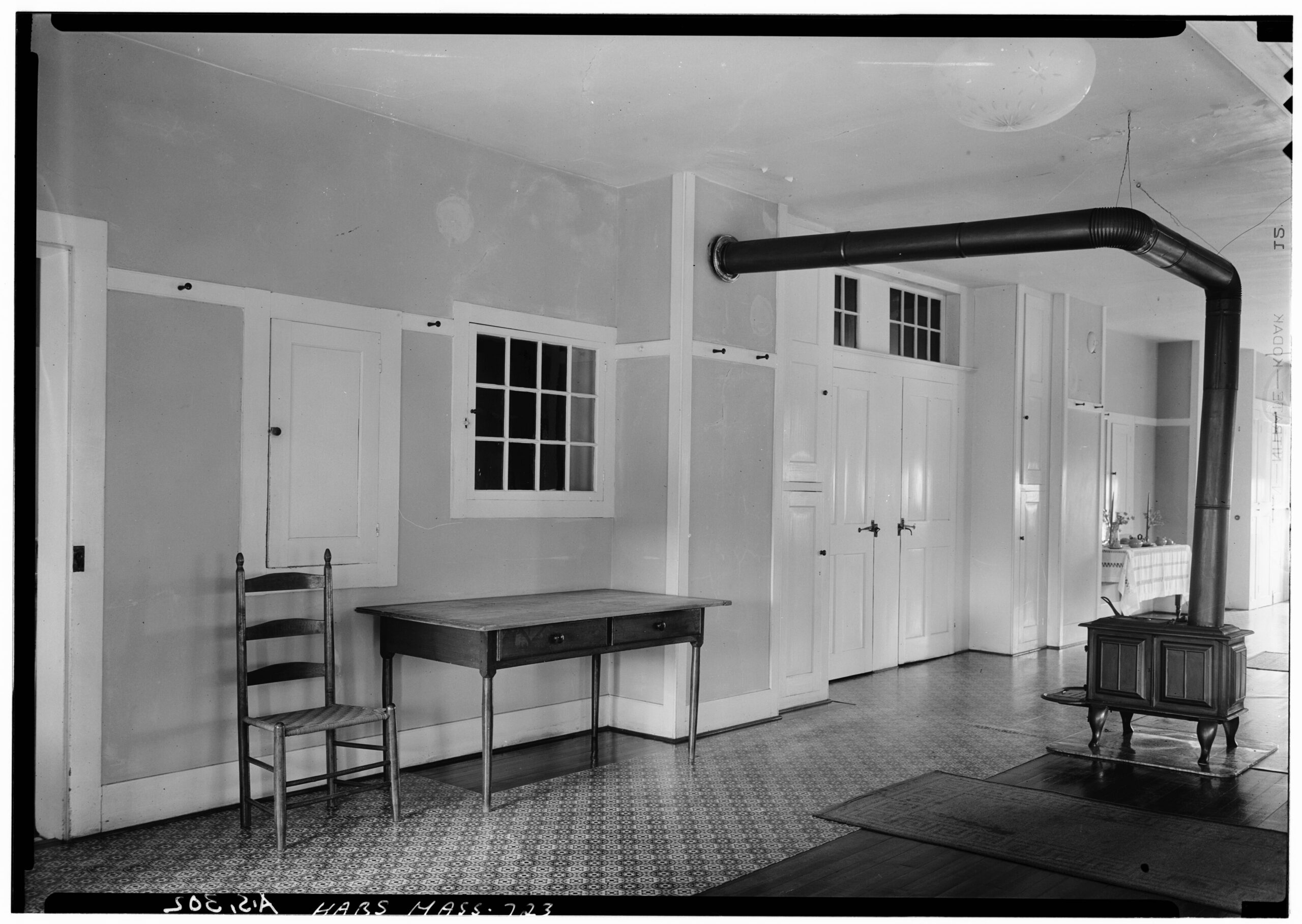 Two photographs by William F. Winter. Above: Sister Anna Case’s room, 1930, with patterned carpets and wallpaper, pictures, an ornamental stove and furniture from different periods. Below: part of the dining room in the Church Family dwelling at Hancock, 1931, with a few isolated objects, pale surfaces and an almost empty floor. Photographs of this kind helped create two very different images of the Shaker past. Historic American Buildings Survey, Library of Congress, public domain.
The difference was not that some rooms were cluttered and others tidy. It was that some were photographed as they were, while others were photographed as they were supposed to be. Edward and Faith Andrews cleared disused rooms, brought in objects from their own collection and staged the photographs with Winter. The same corner might play a dining room, a tailoring room or an infirmary: the props and caption changed, while the same spare, ordered composition remained intact. Winter himself admitted that before releasing the shutter he removed whatever spoiled the picture and shifted whatever ought to have stood elsewhere.[7]
In other words, the photograph read for decades as a record of a Shaker interior was a staging of a Shaker interior. Not a fake — the objects were genuine. They were simply arranged to confirm a thesis that nobody had yet stated aloud.
This does not invalidate the work of the Andrewses and Winter, and it would be dishonest to pretend otherwise. They rescued objects from decaying settlements, studied their construction and prevented them from being dispersed among attics and dealers; without their collections and publications, we would know far less about Shaker furniture. But they also did something less innocent: they decided what deserved attention in the first place. In the 1937 volume Shaker Furniture, they selected the pieces they considered most perfect and presented them in Winter’s black-and-white photographs. In time, slender tables, lightweight chairs and empty interiors came to stand for the whole tradition. A selection of the exceptional quietly disguised itself as a description of the typical.
The moment could hardly have been more receptive. America was searching feverishly for an artistic tradition of its own, one that did not have to be imported from Europe, and Shaker objects — home-grown, useful and conveniently anonymous — made an excellent ancestry. Nobody had to bend them to fit modernism. It was enough to choose the photographs.
The instrument that consolidated this ancestry was the Index of American Design, a federal programme operating from 1935 to 1942 and one of the projects that employed artists during the Depression. Its artists produced more than seventeen thousand meticulous renderings of historic American objects; the programme gave them work while simultaneously assembling a catalogue of native forms for contemporary designers. Shaker furniture was given a prominent place — precisely rendered, usually against a blank background, without an interior and without a human figure. This made it possible to study proportion and detail, while once again removing the object from life and turning it into an autonomous composition.[8] A chair on which somebody had once sat for twelve hours at a laundry table became a graphic image.
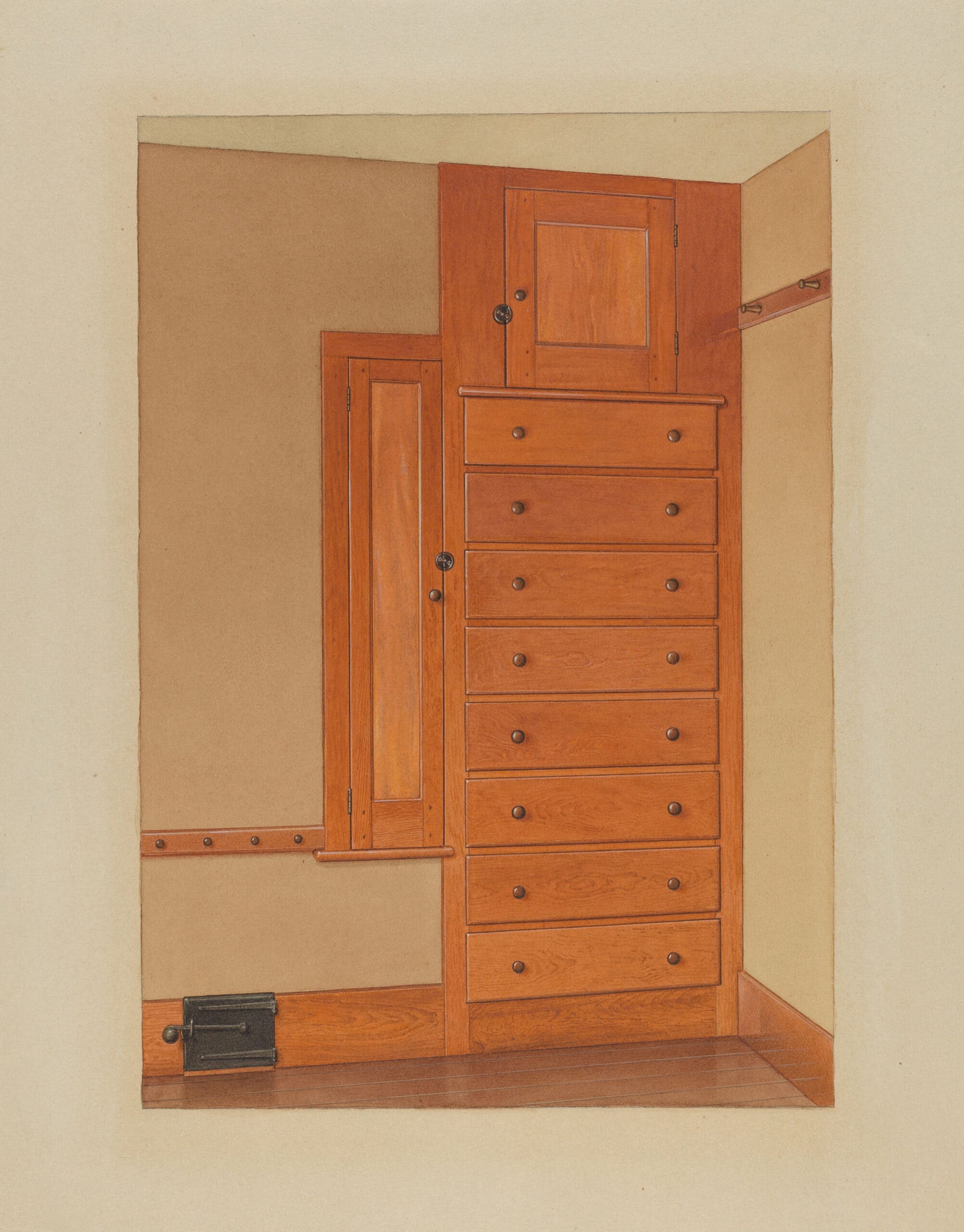 “Shaker Built-In Cupboard”, 1935–1942. This watercolour from the Index of American Design presents part of a working interior as an autonomous composition. The built-in fitting becomes both a document and a ready-made model for the contemporary designer. Artist unknown, watercolour and graphite on paper, Index of American Design, National Gallery of Art, accession no. 1943.8.17150, public domain.
Equally revealing is what the canon refused to admit. Late Victorian furniture, patterned wallpaper, chromolithographs, carpets and ornamental cast-iron stoves did not suit the emerging image of Shaker simplicity, so they fell outside the frame as “foreign influence”, “deviation” or “evidence of decline”. Decorative smallwares made by Shaker women met the same fate: sewing boxes lined with satin and embellished with ribbon, leather and buttons. They sold extremely well, but it was difficult to see in them a premonition of modernism, so their existence was politely ignored. Formal simplicity was promoted to the essence of the Shaker soul; everything that contradicted the thesis was demoted to an error.
 Shaker oval boxes, Brethren’s Shop, Hancock Shaker Village. Greens, yellows, blues and oranges contradict the later image of the Shaker world as a realm of natural timber and white — colour was the rule here, not the exception. Photograph by Bestbudbrian, 2016, CC BY-SA 4.0.
The canon was not a complete invention. Shaker furniture really could be light, restrained and superbly made. The trick lay elsewhere: a handful of carefully chosen examples were made to represent the community’s entire material culture, while everything else was refused admission.
Not everyone approved when this carefully selected “simplicity” began to be turned into a product. In 1937, Herman Miller launched a series of furniture by Freda Diamond, inspired by objects in the Index of American Design and promoted as modernity rooted in native tradition. Homer Eaton Keyes called the designs the “deformed progeny” of Shaker furniture and declared that they “looked like hell”. Even Andrews, who had himself helped bring these forms into modern circulation, considered the adaptation vulgar.[9] The dispute was no longer about the quality of individual chairs. It had become a question of who had the right to rework the model, and at what point the word Shaker ceased to mean anything at all.
America’s Past Returns as an Import
In the autumn of 1927, the Danish sculptor Einar Utzon-Frank is said to have shown Kaare Klint a No. 7 rocking chair from Mount Lebanon. Klint, who headed the furniture department at the Royal Danish Academy in Copenhagen, instructed his students to trace it to the millimetre, then commissioned a copy from the workshop of Rud. Rasmussen. The finished chair appeared in the firm’s window labelled “designed by Kaare Klint”.[10]
A piece of furniture devised by a community in which individual authorship was regarded as something close to the sin of pride had thus acquired a single, named designer — specifically, one who had not designed it.
This was not theft, nor even an accident of the trade, but a method. At the Copenhagen Academy, historic furniture was treated as material for measurement: broken down into proportions, construction and mode of use, then reassembled for contemporary production. Klint and his students did the same with Chinese chairs, Egyptian stools, the Greek klismos, British campaign furniture and Welsh Windsor chairs. Design did not have to begin with an idea; it could begin with somebody else’s furniture. The Shaker rocker was one item on this list, not its culmination.
What reached Denmark, moreover, was not Shaker material culture but a carefully retouched portrait of it. Photographs from the Andrewses’ book, circulating at the Academy from the late 1930s, showed slender tables and empty interiors while omitting orange beds, yellow walls, decorative boxes, the factory chimney and successive layers of paint. The Danes therefore received an image already filtered once by American collectors: simplicity without the context that might complicate it. They copied a reproduction of somebody else’s selection and took it for the original.
The example cited most often is the J39 chair designed by Børge Mogensen for FDB Møbler in 1947 — Folkestolen, “the People’s Chair”, known in English simply as the Shaker Chair, although it was not a copy of any single model. Maggie Taft identifies traces of Shaker forms in the work of other Danish designers too, but cautiously: they did not constitute a separate, pure lineage, only one of the many historical strands that the Copenhagen school dismantled and reworked.[11] More important than any individual piece is what happened to the whole.
After the war, Danish furniture arrived in an America almost perfectly prepared to receive it. It combined modern form with timber, traditional joints and visible quality — modernity without rupture, foreign without seeming alien. The American public had already trained its eye: for two decades it had been shown slender legs and woven seats in exhibitions and department stores as part of its own native tradition. Danish furniture could therefore look both avant-garde and familiar, because Americans had already been taught to recognise these forms as their own.
Here the loop closes with a neatness no screenwriter would dare put on the page. Americans selected from their past the objects that suited modernism. The selection travelled to Denmark and served Danish designers. After the war it crossed the Atlantic again as “Scandinavian modernism”, and America delightedly bought, as a foreign novelty, a religion-free distillation of itself. This did not prove the existence of a single unbroken tradition. It merely helped such a tradition to be narrated — and a story, it turns out, sells better with an imported label.
Somewhere in this circulation, the word Shaker ceased to indicate a place and a people and began instead to denote a set of qualities: simplicity, utility, care, restraint and “historical rootedness”. The package could be transferred from chair to table, from table to interior, and eventually to almost anything. It was far more convenient than the real history. It required no footnotes.
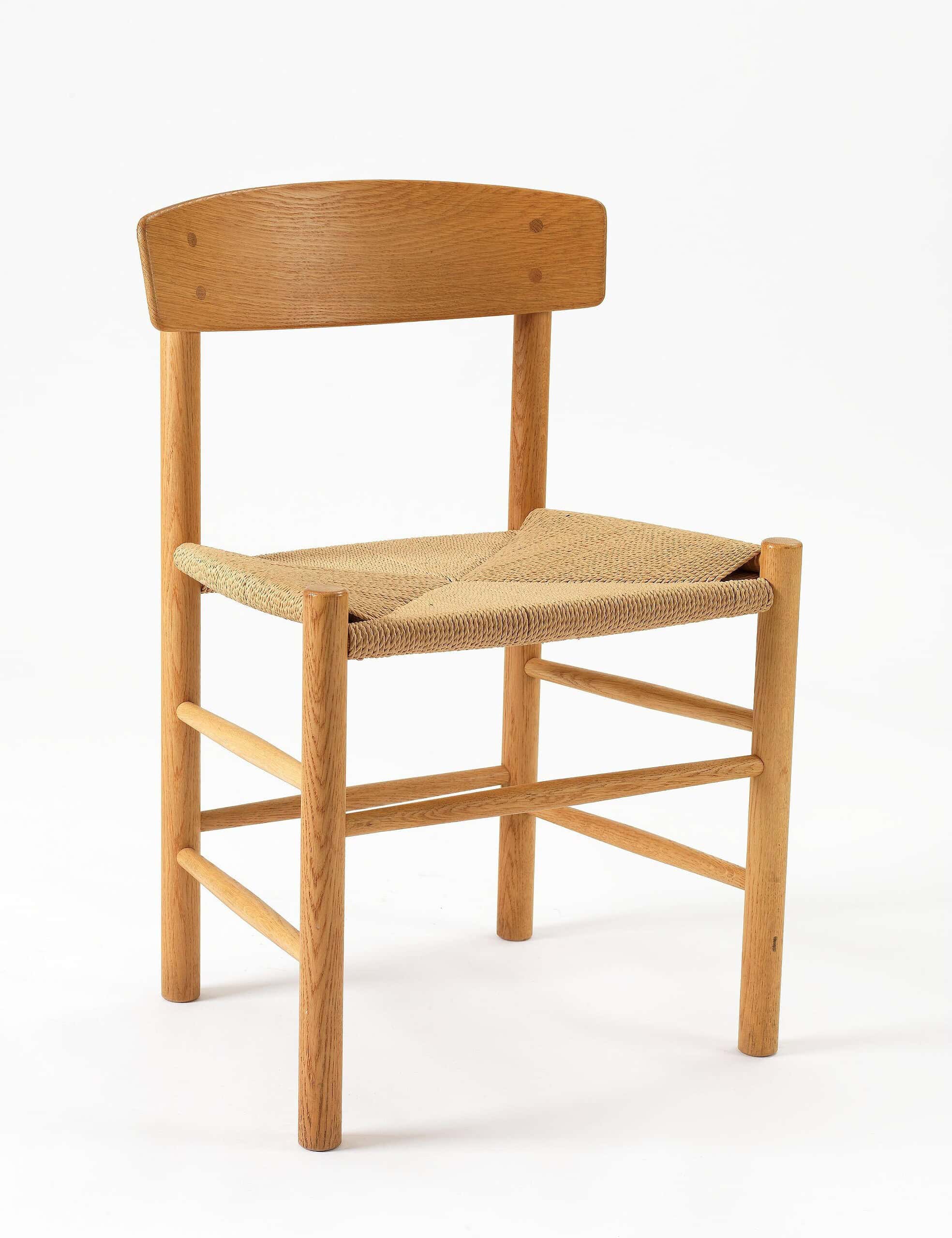 Børge Mogensen, Shaker — the manufacturer’s title, FDB Møbler. A chair in lacquered oak with a paper-cord seat, from a model produced between 1948 and 1976. The name of the former religious community now functions as the designation of a contemporary product and a recognisable repertoire of forms. Nasjonalmuseet, photograph by Frode Larsen, CC BY-SA 4.0.
 Rocking chair with a slat back and woven seat, New Lebanon community (later Mount Lebanon), c. 1820–50. The Shakers made chairs of this type both for their own use and for sale outside the community. This form — turned posts, horizontal slats and a woven seat — later acquired the status of “the Shaker chair” and served Danish designers as a model. Maple and birch. The Metropolitan Museum of Art, New York, accession no. 66.10.23, public domain.
Celibacy and the Family Kitchen
The historic Shaker kitchen was not the cosy heart of the home. It was an operation.
The Church Family kitchen at Hancock was designed to serve nearly a hundred people. It contained large ovens and kettles, extensive service areas and running water at several points. Even the floor was planned deliberately: stone where fire posed a danger, timber where people stood for hours because it was less tiring underfoot. A single firing of the oven was used in sequence for bread, cakes, biscuits and beans — nothing could be wasted. It had more in common with a bakery or a barracks kitchen than with a room in which a family gathers around the table at the end of the day.[12]
Especially since there was no family there, at least not in the modern sense.
The contemporary phrase Shaker kitchen conjures an almost perfectly opposite image: the kitchen as the centre of married life and childhood, a large table, natural wood, the serenity of domestic rituals, couples holding hands over a chopping board. A Shaker “family”, however, was not a married couple and their children but a celibate community — people who vowed never to have a spouse or children and regarded sexual desire as the root of all evil. Their kitchen did not celebrate family life. It kept alive a hundred adults to whom family life was forbidden.
It would be difficult to find a cleaner example of a name that has outlived its meaning and begun to serve its opposite. The Shaker community arranged its kitchen for a life without marriage or descendants. The market now sells it as a temple to the family. One minor detail went missing — the entire content. The pleasant name remained.
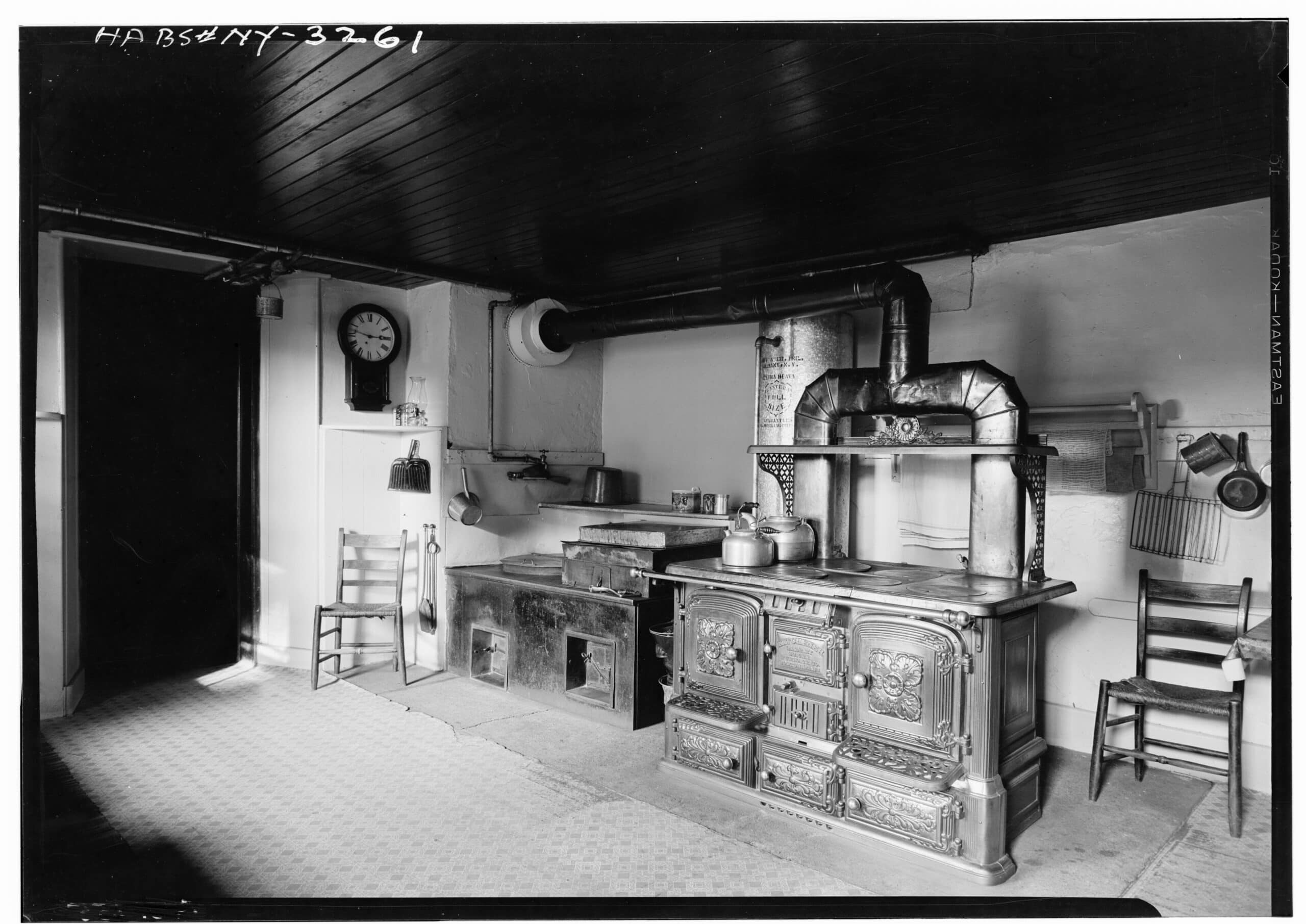 The South Family kitchen at Watervliet, 1920s or 1930s. Hearths, vessels, tools and an ornamental cast-iron stove create an image closer to the technical infrastructure of communal life than to today’s vision of the cosy “Shaker family kitchen”. Photograph by William F. Winter Jr., Historic American Buildings Survey, Library of Congress, public domain.
The distinguishing feature of such a kitchen is now held to be the cabinet door with a plain frame around a flat, recessed panel. Shaker joiners did indeed use it — in doors, cupboards and built-in fittings. It was durable, allowed large surfaces to be assembled from smaller elements and accommodated the natural movement of timber. But they did not invent it. Frame-and-panel construction belonged to the alphabet of European and American joinery long before the first Shaker picked up a chisel. Stiles and rails were joined with mortise-and-tenon joints, and the panel was set loosely so that it could move. The Shakers did not invent the construction. They simply made it well — and that, in fairness, no one can take away from them.[13]
A contemporary cabinet door sold as Shaker need no longer contain either mortise-and-tenon joints or a separate panel free to move within the frame. It can be routed from a single sheet of MDF. The name then describes not the construction of the furniture but its memory: the rectangle of the frame and the recessed centre, an imprint of a structure no longer present beneath the surface. This does not make the door inferior. It means only that the old solution has been reduced to a profile — a shape that can be repeated in any material, detached from the reason it once existed.
A Chair or Absolution
In the second half of the twentieth century, the same logic extended to an ever wider range of goods. First came reproductions: chairs, tables, shelves and oval boxes. Then the name was applied to furniture merely “in the spirit” of the historic models. Eventually it encompassed entire interiors — pale timber, plain lines, woven baskets and carefully calculated signs of modesty. Shaker and “Shaker” products filled the catalogues of Habitat, IKEA, Heal’s, Marks & Spencer and Laura Ashley: kitchens, clocks, textiles, bedside cabinets, bathroom fittings and complete coordinated schemes. In one case described by Bowe and Richmond, a “Shaker-style” kitchen was assembled from boxes and accessories sourced from several different chains at once.[14] A community that had subordinated its whole life to a single idea returned as a receipt from several shops.
It would, however, be too easy to make this a story of innocent craftsmanship trampled by a cynical market, because the Shakers traded on their own account. They manufactured for sale, built factories, printed catalogues, developed networks of buyers and defended a trademark. Commerce did not arrive only when the communities began to die out. What changed was the thing being sold. A nineteenth-century catalogue offered a chair of a given size, construction and price. The later catalogue offers a promise along with the object: order, moderation, calm, release from excess. The furniture need no longer have been made within a community or faithfully reproduce a historic model. It need only produce the correct mood. Once, one bought a chair. Now one buys absolution for owning too much — included in the price of the chair.
The religious doctrine evaporated from the story. Its moral tone proved considerably more durable: mortification was repackaged as a lifestyle, penance as a colour palette. This does not mean that nothing genuine survived the journey. Shaker furniture really can teach attentiveness — to proportion, weight and material, to the way an object sits in the hand and performs its task. Frame-and-panel construction remains a sensible solution, and its industrial version can be good design. The trouble begins where a commercial label replaces history and a handful of selected characteristics begins to impersonate an entire former world. Out go the loud colours, the factory chimney, the trademark, Victorian abundance, decorative boxes sewn by women and every successive layer of paint. What remains is pale timber, an empty wall and the pleasant conviction that this is what Shaker simplicity truly looked like.
The earliest accounts of the Shakers described people whose bodies could not be kept still. Movement was then contained in choreography, the community in regulations, the day in a timetable and its possessions in 860 drawers. In the twentieth century, objects closest to modern taste were selected from this dense, contradictory world and declared to be its essence. “Shaker style” is therefore not a straightforward inheritance from the community, but the sum of other people’s choices: what was offered for sale, what collectors preserved, what was arranged for the camera, what modernism embraced and what the market found easy to repeat.
The Shakers themselves would probably not have been surprised. They knew how much work was required to make a thing look simple. At first, the word Shaker meant people prepared to give their entire lives to an idea. Today, it most often means the way a cabinet door is divided.
Notes
[1] Stephen J. Stein, The Shaker Experience in America: A History of the United Society of Believers, Yale University Press, New Haven–London 1992, pp. 3–10, 41–56, 66–80, 104–105. Stein discusses early accounts of ecstatic practice, the later theology surrounding Ann Lee and the gradual regulation of the community’s liturgy and organisation.
[2] Paul Rocheleau, June Sprigg, Shaker Built: The Form and Function of Shaker Architecture, The Monacelli Press, New York 1994, pp. 94–103, 124, 136. Individual communities used different architectural means to separate women and men, including entrances, staircases, corridors and entire wings.
[3] Edward Deming Andrews, Faith Andrews, Shaker Furniture: The Craftsmanship of an American Communal Sect, Yale University Press, New Haven 1937, p. 77; Shaker: Furniture and Objects from the Faith and Edward Deming Andrews Collections, Renwick Gallery, Smithsonian Institution, Washington 1973, p. 71; Paul Rocheleau, June Sprigg, Shaker Built…, pp. 164–165.
[4] June Sprigg, Shaker Design, Whitney Museum of American Art and W. W. Norton, New York–London 1986, p. 26. The functional explanation for the tapering drawer sides comes from contemporary cabinetmakers; no Shaker record survives to explain the maker’s intention.
[5] Charles R. Muller, Timothy D. Rieman, The Shaker Chair, The Canal Press, Canal Winchester 1984, pp. 169–186; Edward Deming Andrews, The Community Industries of the Shakers, University of the State of New York, Albany 1932, pp. 65, 103–104. The first study documents the factory, its workforce and warnings against imitations; the second corrects the myth of complete communal self-sufficiency.
[6] Susan L. Buck, “Shaker Painted Furniture: Provocative Insights into Shaker Paints and Painting Techniques”, in Painted Wood: History and Conservation, eds Valerie Dorge and F. Carey Howlett, Getty Conservation Institute, Los Angeles 1998, pp. 143–154.
[7] Stephen J. Stein, The Shaker Experience…, pp. 375–376; Stephen Bowe, Peter Richmond, Selling Shaker: The Commodification of Shaker Design in the Twentieth Century, Liverpool University Press, Liverpool 2007, pp. 22–24. The sources discuss the staging of interiors for photography, the repositioning of objects and the influence of Winter’s photographs on the later image of Shaker interiors.
[8] William D. Moore, “‘You’d Swear They Were Modern’: Ruth Reeves, the Index of American Design, and the Canonization of Shaker Material Culture”, Winterthur Portfolio, vol. 47, no. 1, 2013, pp. 1–34, especially pp. 27–30.
[9] Ibid., pp. 30–32. Homer Eaton Keyes’s phrases — “deformed progeny” and “looked like hell” — are quoted in the original.
[10] Maggie Taft, “Morphologies and Genealogies: Shaker Furniture and Danish Design”, Design and Culture, vol. 7, no. 3, 2015, pp. 315–317. The detailed account of the chair shown to Klint was not recorded until a 1977 exhibition catalogue; the cautious formulation “is said to have shown” is therefore used in the text.
[11] Ibid., pp. 317–329. The J39 is now dated to 1947 by Designmuseum Danmark and its current manufacturer, Fredericia. Taft also shows that the Shaker repertoire was one among several historical sources used by Danish designers.
[12] Paul Rocheleau, June Sprigg, Shaker Built…, pp. 166–169. The description of the Church Family kitchen at Hancock covers the scale of work required to feed almost a hundred people, the ovens and kettles, the water supply and the use of different flooring materials in areas exposed to fire and prolonged standing.
[13] Edward Deming Andrews, Faith Andrews, Shaker Furniture…, pp. 80, 88, 91. The authors describe Shaker uses of flat and recessed panels set within frames.
[14] Stephen Bowe, Peter Richmond, Selling Shaker…, pp. 258–266, 282–286. The authors discuss Shaker and pseudo-Shaker products in British catalogues and the gradual transformation of a historical name into a general category of style.
Bibliography
Andrews, Edward Deming, The Community Industries of the Shakers, University of the State of New York, Albany 1932.
Andrews, Edward Deming, and Faith Andrews, Shaker Furniture: The Craftsmanship of an American Communal Sect, Yale University Press, New Haven 1937.
Bowe, Stephen, and Peter Richmond, Selling Shaker: The Commodification of Shaker Design in the Twentieth Century, Liverpool University Press, Liverpool 2007.
Buck, Susan L., “Shaker Painted Furniture: Provocative Insights into Shaker Paints and Painting Techniques”, in Painted Wood: History and Conservation, eds Valerie Dorge and F. Carey Howlett, Getty Conservation Institute, Los Angeles 1998, pp. 143–154.
Moore, William D., “‘You’d Swear They Were Modern’: Ruth Reeves, the Index of American Design, and the Canonization of Shaker Material Culture”, Winterthur Portfolio, vol. 47, no. 1, 2013, pp. 1–34.
Muller, Charles R., and Timothy D. Rieman, The Shaker Chair, The Canal Press, Canal Winchester 1984.
Rocheleau, Paul, and June Sprigg, Shaker Built: The Form and Function of Shaker Architecture, The Monacelli Press, New York 1994.
Shaker: Furniture and Objects from the Faith and Edward Deming Andrews Collections, Renwick Gallery of the National Collection of Fine Arts, Smithsonian Institution, Washington 1973.
Sprigg, June, Shaker Design, Whitney Museum of American Art and W. W. Norton, New York–London 1986.
Stein, Stephen J., The Shaker Experience in America: A History of the United Society of Believers, Yale University Press, New Haven–London 1992.
Taft, Maggie, “Morphologies and Genealogies: Shaker Furniture and Danish Design”, Design and Culture, vol. 7, no. 3, 2015, pp. 313–334.