Terrazzo: from Venetian seminato to Polish lastryko — and back
In the 1990s, terrazzo was being chipped out of Polish homes: windowsills, stair treads, stairwell floors. In Poland the material had a name of its own — lastryko — and by then it had become tightly associated with the drab institutional world of the Polish People’s Republic (PRL), which had ended in 1989; it was often replaced with porcelain tile or stone-effect conglomerates. The same reflex ran through much of post-communist Central Europe, and it was only a sharper local version of something that has happened to terrazzo again and again: a material falls out of fashion, is torn out wholesale, and comes back a generation later wearing a different name.
Three decades on, the same kind of surface is returning to the same interiors, now under the Italian word terrazzo. It is not, however, exactly the same material. Modern systems can be cement- or resin-based, poured in place or precast, massive or thin-layered. What they share is a principle rather than a recipe: chips of hard material set into a binder, then ground back so that their cross-section is exposed.
You could read this as an ordinary change of fashion and vocabulary. What is more interesting is that this material had been changing names much earlier — and almost every one of those names said more about how the work was done than about how the finished floor looked. In Venice, where its well-documented modern history begins, one of the terms was seminato: “sown.”
I. Sown
The principle is simple: hard chips are set into a soft binder, and once it has set, the whole surface is ground down. What we later walk on is not a layer of pebbles but their cross-section — flat, sealed, carrying a pattern that no one painted.
The name seminato, “sown,” comes from the gesture. The aggregate was not laid like mosaic, piece by piece. It was scattered across a prepared layer like seed: the larger fragments first, then the medium ones, and finally the fine grit that filled the gaps. Everything was tamped down until the aggregate settled firmly into the base. The final surface was only fully revealed by grinding, when the protruding fragments were cut back to a common plane and their cross-sections exposed.
In the mid-eighteenth century, Gaetano Zompini portrayed a Venetian terrazzer at work. The text accompanying the engraving is a small advertisement for the trade: the craftsman assures us that he makes ornate and costly floors, but also keeps old ones in good repair. Repair was not a lesser occupation than new work. It belonged to the same skill.

Venice, c. 1753. A terrazzer at work — an engraving by Gaetano Zompini from a series documenting the street trades of the city. The caption, in dialect, says more than the image: “I make grand terrazzo and marmorino, and keep the old ones in good repair around the houses; I can also make the kind worth sequins.” An eighteenth-century advertisement for the trade lists the repair of old floors in the same breath as luxury commissions. Gaetano Zompini, “Le arti che vanno per via nella Città di Venezia,” 1753; public domain.
For its first three centuries, the ideal of this technique was not a pattern but its opposite: a single unbroken sheet, running across an entire hall without seams or divisions, ground so smooth that chroniclers compared it to a mirror. Decoration was usually limited to a border framing the field in a different tone. In the Hall of the Great Council in the Doge’s Palace, the Venetian floor forms a nearly unbroken sheet covering more than 1,300 square metres (about 14,000 square feet). There, decoration yields to continuity. In a city where a marble floor had to be assembled from separate slabs, the absence of divisions was itself a luxury.

Venice, Palazzo Ducale (Doge’s Palace), Hall of the Great Council. More than 1,300 square metres of Venetian floor form a nearly unbroken, gleaming plane. For centuries the greatest luxury in terrazzo was not the pattern but the lack of divisions. Chroniclers praised it as “smooth as a mirror.” Photo: Adrian Scottow, CC BY-SA 2.0, Wikimedia Commons.
The historical terms do not add up to one tidy dictionary. In the sources, the names seminato, pavimento alla veneziana and terrazzo are used more broadly or more narrowly. Francesco Sansovino wrote in 1581 of “a certain material called terrazzo,” durable, pleasing to the eye, and smooth. Other authors distinguish pavimento alla veneziana — with larger fragments laid more densely — from the cheaper, scattered seminato. There is no need to force these differences into line. The old makers needed a good way to make a floor, not an international product classification.
The technique matters more. The Venetian floor was not simply a primitive version of the modern cement mix. The stone chips were not combined with the binder beforehand into a uniform mass. They were scattered onto a damp, multi-layered lime base and then pressed into its surface during tamping. Only the spread of Portland cement in the nineteenth century brought a different method: the aggregate was increasingly mixed with the binder before the floor was laid. The finished surface, though, will still look familiar.
Venice’s palaces stand on wooden piles and shift slightly over the centuries. The floor therefore had to endure something a stone slab dislikes: small, long-lasting deformations of the structure below. It was not flexible in today’s sense, but it was a thick, layered construction that worked together with the wooden beams. After drying and grinding, the floor was finished with, among other things, linseed oil. This was not a matter of oiling it every few weeks, as a careless reading of old descriptions might suggest. The oil soaked into the pores and, after a few weeks, set — reducing dusting and the penetration of water. The technique demanded patience even when the floor already seemed finished.

Venice, Ca’ Pesaro. A colourful, ground floor forms an expansive backdrop for Arturo Martini’s “La Pisana” of 1928. Photo: Didier Descouens, CC BY-SA 4.0, Wikimedia Commons.
The heart of the matter was the grinding. A freshly laid surface is uneven: the stones protrude from the binder and their shapes are only partly visible. Grinding does not smooth the ridges alone. It shears them off together with a layer of binder, until everything lies in a single plane. Each fragment is cut through like a loaf of bread. The floor’s drawing is created precisely in this cut — before it, it physically does not exist.
This distinction is useful when looking at modern imitations. Porcelain stoneware, laminate or wallpaper can reproduce the characteristic speckling very well. There is nothing wrong with that; they are sometimes a sensible choice. But they are made the other way around. They copy the image of a finished surface, skipping the process. In real terrazzo, beneath the visible fleck lies the rest of the same stone. In an imitation, it ends with the print.

Vienna, Museum of Technology. A manufacturer’s sample from 1934: three stages of a cement floor on a single specimen. From the left: the backing concrete with ordinary gravel; the working layer — selected marble granulate rolled into the mortar, still under its cloudy, fresh top; the same layer after grinding. A few ground-off millimetres separate the central field from the right. Photo: Geolina163, CC BY-SA 4.0.
The very idea of a smooth floor made of small, hard fragments set in a binder is older than Venice. The oldest known examples, uncovered at sites in eastern Anatolia, are about nine thousand years old. The Romans had their own version — opus signinum, a floor of crushed ceramic and lime, still walked on today in Pompeii. But kinship of idea must be distinguished from continuity of craft. No unbroken chain of people, workshops and transmitted skills runs between Anatolia, Rome and Venice. A shared idea is not the same as an unbroken trade. That can only be traced once specific people appear — a guild statute, workshops, and names that recur across generations.

Venice, Ca’ Rezzonico, ballroom. The dark, gleaming sheet of the floor does not compete with the painted decoration of the walls and vault. It binds the vast interior together and reflects the light of the enormous chandeliers. Photo: Sailko, CC BY 3.0, Wikimedia Commons.
II. A Trade from a Handful of Villages
A technique does not move on its own. It needs people. In the case of terrazzo, for several centuries they came from an area so small that on a map it looks almost like an accident.
On 9 February 1583, the Venetian Council of Ten permitted master Sgualdo Sabadin and his companions, practitioners of the arte dei terrazzeri — the art of terrazzo — to form a guild under the patronage of Saint Florian. Three years later, the first chapters of the statute were written down, the Mariegola de’ Terazzeri. The guild was Venetian, but most of its founders did not come from Venice. Sabadin came from Provesano, a village at the foot of the Alps in Friuli, a good ninety kilometres from Venice. The other founding masters came from neighbouring places — Barbeano, Sequals, Solimbergo and Fanna. What is more, in the guild registers the same villages and the same surnames return generation after generation — Pellarin, Crovatto, Mazzioli, Del Turco, Foscato, Pasquali — as if someone kept recopying the phone book of those few localities. The trade in one of the richest cities in Europe was mastered, then, by newcomers from the provinces — and not from the whole region, but from a handful of villages whose names will recur throughout this story: Sequals, Solimbergo, Fanna, Cavasso Nuovo, Arba, Spilimbergo, Barbeano and Provesano.

Venice and eight Friulian localities within a radius of a dozen or so kilometres. From these few villages came the masters of the 1583 Venetian guild, the restorers of Roman mosaics in nineteenth-century France, and the founders of most New York flooring firms a hundred years later. Map by the author.
The strangest part is that the craftsmen from these villages almost never worked at home. They travelled to Venice and the cities of northern Italy, then to France, Germany, Britain and America. In some families this way of life lasted for centuries. A boy from Sequals learned a trade that could not be practised in Sequals; his working life was by design lived elsewhere, and in some families that model persisted for generations. These villages did not produce floors. They produced people with knowledge that distant cities needed.
The knowledge passed through family, workshop and trusted apprentices. The road to mastery was long: seven years of training as a garzone, then three years working as a lavorante, and only then the master’s examination. Ten years may seem excessive for a technique whose principle can be explained in a few sentences. Except that the principle is not yet a skill.
You can write down the proportions of the binder, the fractions of the aggregate and the arrangement of the layers. It is harder to describe the moment when the mix has the right density, the base the right moisture, and the embedded stones can be ground without being torn out. The answer depends on the material, the weather, the structure and the behaviour of the particular floor. Documentation is indispensable, but it will not do the work by itself. This less tangible part of the trade lived in the eye, the hand and the memory of other people’s mistakes. The first school teaching the Friulian techniques, the Scuola Mosaicisti del Friuli, was founded in Spilimbergo only in 1922. Before that, for more than three centuries, the only real textbook was another human being.

A historical photograph from the Scuola Mosaicisti del Friuli in Spilimbergo. The school was founded in 1922. Before that, the local mosaic and terrazzo techniques were passed on within families and workshops, through years of apprenticeship to a master.
The fall of the Venetian Republic in 1797, and the formal dissolution of the guilds ten years later, did not end the profession. The masters had the skills, the tools and a network of contacts, so they could work on their own account. The old guild organisation began to give way to small family businesses. The trade was easy to relocate: its most valuable equipment did not have to be packed into a crate.
In the early nineteenth century, in the south of France, more and more Roman mosaics were being uncovered. People were needed who could lift, move and repair them. Around 1829, Angelo Mora of Sequals, who had earlier worked in Venice, settled in Lyon and founded a mosaic firm there; it was later run by his sons, Edoardo and Pietro. Others followed him, heading for Nîmes, Montpellier, Narbonne and Avignon.
The story turns here, for a moment, from terrazzo toward mosaic, because for a long time the two crafts belonged to the same milieu. The same people laid decorations, made floors, ground surfaces and founded firms covering both specialities.
The best-known figure in this network was Gian Domenico Facchina, born in Sequals in 1826. His path shows how the whole milieu worked. As a boy he was sent to a relative in Trieste, where he learned drawing and helped restore mosaics in the cathedral of San Giusto. Later his uncle Giuseppe, a cleric at the Basilica of Saint Mark, introduced him to the Venetian workshops. Each stage of his training was arranged by a family stretched across several cities.
Around 1847, Facchina followed his countrymen to the south of France, where he founded his own firm. In 1858 he patented an indirect method that changed the scale of the whole craft: the mosaic was assembled in the studio, face down on paper, divided into sections, transported and mounted on site. This made it possible to separate design, execution and installation, and thereby to increase the scale of production. The craft did not become less demanding as a result. It became possible to organise almost industrially. In 1866, Facchina and the firms of his countrymen made the mosaics of the Paris Opéra Garnier. It was the first public building in France with mosaic decoration on such a scale, which the architect himself honoured with an inscription inside the building.
The trade reached the United States, then, not straight from the Friulian villages but by way of Paris, Lyon, London and other European centres. The newcomers already had experience, contacts and the addresses of workshops run by their countrymen. In 1880, Facchina sent two masters to New York — Luigi Zampolin of Spilimbergo and Filippo Crovato of Sequals — to work on William H. Vanderbilt’s residence on Fifth Avenue. The construction and decoration were handled by the firm Herter Brothers. A year later, it set up a separate mosaic department. Its joinery shops were dominated by Germans, while all the mosaicists it employed were Italians. Many of them later founded their own firms.
Against the backdrop of mass Italian emigration, they were a small, distinctly separate group. Most arrivals were registered as agricultural or unskilled labourers; the mosaicists and terrazzo workers from Friuli were called the “aristocracy” of the Italian workforce. The term was condescending, but it captured their position: they did highly specialised work that was hard to replace.
Specialisation gave them a strength that most Italian emigrants did not have. In the spring of 1890, New York’s mosaicists went on strike, demanding a nine-hour working day, shorter Saturdays and a daily wage of $3.50. At Herter Brothers they were supported by the German joiners, varnishers and painters, who also put down their tools. In a working world divided by languages, trades and countries of origin, this was not an obvious scene. The trade turned out to be not only portable capital, but also a tool of negotiation.
In time, enterprise became more important than union activity. The craftsmen founded firms, employed relatives and further apprentices, and their names appeared not only on payrolls but also on contractors’ signboards. In 1924, Costante “Gus” Cassini of Cavasso Nuovo invited twenty-seven mosaic and terrazzo contractors to Chicago. Out of that meeting grew the organisation that was the predecessor of today’s National Terrazzo & Mosaic Association.
The old guild turned into a network of firms, then into a trade association. People, tools and legal forms changed. The knowledge still travelled through the same families and localities. One of the names will return later in this story. Del Turco — first present in the registers of the Venetian trade — will reappear in New Jersey, attached to an invention that changed the look of modern terrazzo.
III. When the Machine Stepped onto the Floor
Between the nineteenth and early twentieth centuries, terrazzo changed in ways that would transform its scale. First came a new binder, then a new tool. Neither change was spectacular, but without them the material would not have entered railway stations, hotels, department stores and office buildings.
The first change was brought by Portland cement. In the Venetian technique, the aggregate was scattered onto a prepared lime base and driven into it during tamping. Modern terrazzo began to be made differently: chips of marble were mixed with cement into a single mass, which was spread on the base and ground once it had set. In Europe a similar technique was in use at least from the 1870s, in the United States from the end of the century.
Almost everything changed, then: the recipe, the way of working and the behaviour of the material itself; soon the scale on which it could be used would change too. Modern terrazzo did not arise from faithfully repeating the old technique, but from thoroughly reworking it. The surface could still look familiar: pale binder, stone chips, a smooth grind. Underneath, though, was now a different material, made by a different method and behaving differently toward its base. The continuity of terrazzo did not lie in fidelity to a single recipe. It lay in preserving a principle: aggregate, binder, grind.
The grinding was still the hardest part of the work. It was done with a galera: an abrasive stone fixed to a long pole of iron pipe, pushed back and forth across the set surface until the unevenness came off. Metre by metre, with the full weight of the body, wet. The galera, used in the nineteenth and early twentieth centuries, had a much older ancestor. In Giovanni Antonio Rusconi’s treatise of 1590, a heavy block of stone or lead, called an orso, is shown being dragged on ropes across a freshly set floor. The tools changed shape, but the principle long stayed the same: the surface was levelled by a weight moved by the force of human arms. In archival photographs several men stand side by side, each bent over his own patch of floor. It does not look like a romantic, lost art. It looks like work that left your back aching.

Grinding terrazzo with galeras, early twentieth century. An abrasive stone was fixed to a long pole and moved repeatedly across the wet floor. Electric grinders sped up the work; they did not relieve the makers of understanding the material. Archival photograph, author unknown.
Electric grinders began to spread in the early twentieth century — first in Germany, where the industry was then developing most vigorously: around 1910 the first to use them in Mannheim was the entrepreneur Marco Rosa, from Friuli of course, and an Italian bulletin for emigrants called the new machines outright a revolution. In 1916, Antonio G. Ferrarini of Chicago patented a polishing machine. What is interesting, though, is what mechanisation did not do: it did not weaken the position of the masters. Grinding and polishing — the heaviest work, but not the most difficult — belonged to the helpers, so it was the helpers whom the machine replaced. Decisions about the mix, the pattern and the timing of each stage stayed where they were: with the masters. Technology changed the division of labour, but it did not replace knowledge.
Another decisive change began with a crack. American terrazzo was then poured in one continuous run, in great uninterrupted planes — and in buildings of a new type, tall, with steel frames, those planes cracked. The structure of such a building is constantly flexing and vibrating by tiny amounts, and a rigid floor cannot keep up: the cracks appeared most often over beams and columns. The bigger the building, the harder it was to pretend that the floor had nothing to do with what it rested on. In 1919 the firm L. Del Turco and Brothers of Harrison, New Jersey, filed a system for dividing the surface with brass strips, embedded in the base at regular intervals. The patent was granted to Louis — that is, Luigi — Del Turco in February 1921. He had come to New York from Sequals in 1907. A name known from the Friulian and Venetian registers returned attached to one of the most important inventions of modern terrazzo.

Louis Del Turco’s patent for a dividing strip for cement floors. Filed in September 1919, granted in February 1921. The drawing shows the strip within the layers of the floor and the division of the surface into geometric fields. United States Patent Office, US 1,368,374; public domain.
The strips did not prevent every crack. They allowed cracks to be anticipated and confined to marked lines. They were laid over structural elements and at intervals dividing a larger surface into safer fields. The patent was meant to solve a technical problem, but its decorative possibilities were visible from the start: on the very first drawing, the fields arrange themselves into a geometric composition with a diamond in the middle.
Ornament, of course, existed earlier. In the Viennese floor at Graben 12, coloured aggregates form a flowing, multicoloured pattern without metal contours. Larger surfaces were also divided by rows of mosaic tesserae. Metal did not invent decoration. It gave it something new: a thin, continuous and very precise line. It could run straight, break at an angle, sweep in arcs, separate colours and different kinds of aggregate. An element introduced because of cracking became a tool of drawing.

Vienna, the entrance hall of the tenement at Graben 12. Ornament laid entirely from coloured aggregate — without a single metal strip; the contours are soft, because they were drawn by the hand arranging the coloured fields, not by a brass divider. This is what terrazzo decoration looked like in nineteenth-century entrance halls — before Del Turco’s invention gave ornament a sharp, confident line. Photo: Geolina163, CC BY-SA 4.0, Wikimedia Commons.
Earlier, larger planes were separated by single rows of mosaic tesserae; now metal took up residence in the floor — brass, copper, nickel silver, zinc — and you could draw with it. This was a bigger turn than it seems: the broad, continuous field had long been one of terrazzo’s great effects, while nineteenth-century bourgeois entrance halls and cafés gave ornament a more assertive role — and the metal strip finally gave it something it had never had before: a sharp, confident line.

Haarlem, the hall of the former guardhouse (Hoofdwacht) on Zoetestraat — ornament traced with single rows of mosaic tesserae, set directly into a speckled terrazzo field. Before metal entered floors, this was exactly how larger planes were drawn and divided: the tessera was the line of an age in which mosaic and terrazzo still worked side by side — often in the same threshold. A few decades later the same job would be taken over by the brass strip, sharper and faster. Photo: documentation of the Rijksdienst voor het Cultureel Erfgoed (the Dutch national heritage agency), 1993; CC BY-SA 4.0, Wikimedia Commons.
The new language appeared at the right moment. From the late 1920s, American interiors increasingly drew on the geometry of Art Deco and the flowing lines of the Moderne style. Terrazzo handled both expansive, calm surfaces and bold compositions led by metal divisions. In the 1930s it went into cinemas, hotels, stations, department stores, residential and industrial buildings.

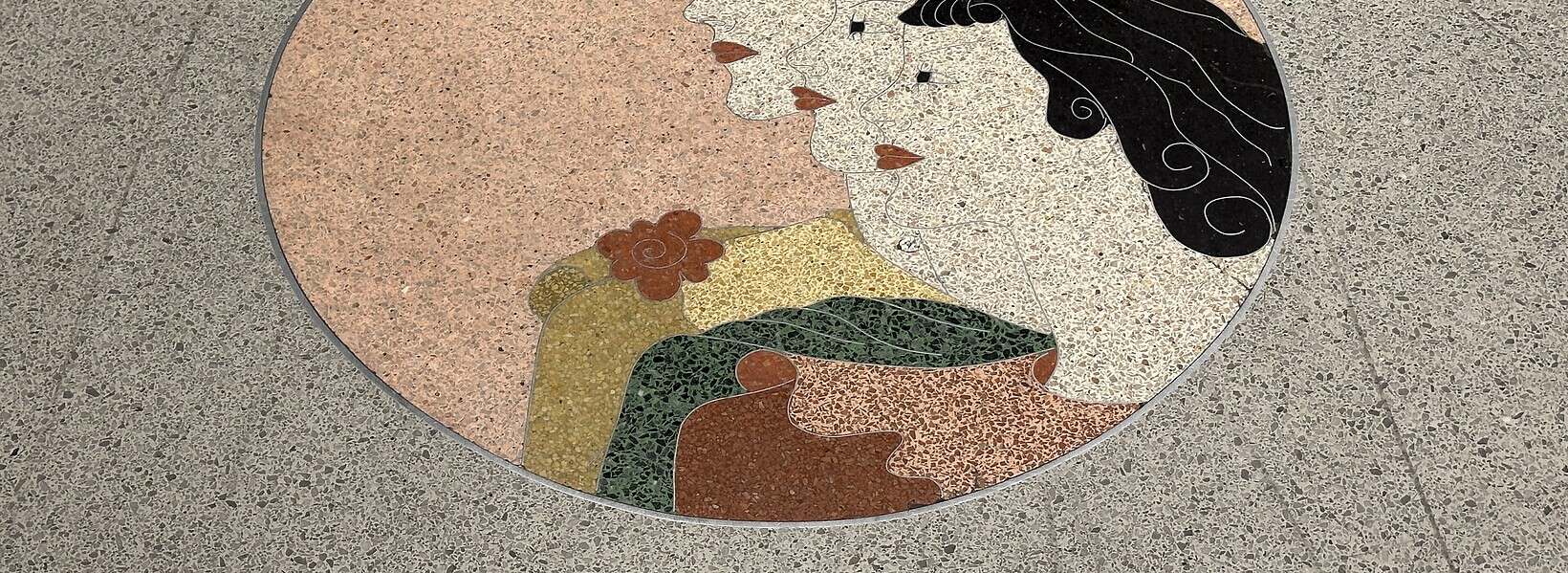
Miami Beach, a floor at the entrance to a building in the Art Deco district, early 1940s. The silhouettes of three women were made from fields of coloured terrazzo separated by a metal strip. The same strip serves both a technical and a decorative function. Photo: Phillip Pessar, CC BY 4.0, Wikimedia Commons.
Up to the mid-1920s, mosaic still dominated among American stone floors; a decade later terrazzo ruled unchallenged. The scale of the era is best conveyed by a single building. In the late 1920s, three firms founded by Friulians — De Paoli, Del Turco and Foscato — together laid the corridors of the Empire State Building: about twenty-three thousand square metres of terrazzo (roughly 250,000 square feet), which took 12,500 bags of cement, 15,000 bags of marble chips and nearly a thousand cubic metres of sand. A commission like that could not be run like a small Venetian workshop. It required the organisation of supplies, a division of labour, mechanical grinding and firms capable of servicing the construction of a skyscraper.


Indianapolis, the former Coca-Cola bottling plant of 1930–1931, now the Bottleworks Hotel — the photographs show the lobby and the staircase. Terrazzo, travertine and brass form a single material ensemble typical of American Art Deco. The interiors were designed as a whole: terrazzo on the floors, glazed tiles on the walls, brass and balustrades — each material in its role. The terrazzo here was laid in the 1930s by the firm Santarossa Mosaic and Tile; the same firm, still in business, came back ninety years later to complete the restoration. Photo: w_lemay, CC BY-SA 2.0, Wikimedia Commons.
It would be easy to turn this into a story of industry’s victory over craft — except that the facts do not fit. Cement changed the binder. The grinder took over the heaviest work. The strip solved the problem of cracking and, along the way, became ornament. And the firms with Friulian names on their signboards passed through all these changes without surrendering the market to anyone. The machine did not kill the craft. It let it enter the scale of the modern city.
IV. Lastryko
By the time terrazzo had spread across Europe and America, it had acquired not only local names but local social meanings, and the two did not always move together. Poland offers an unusually legible case. Here the material became known as lastryko, a word that would eventually come to carry a whole era on its back — and the gap between what that word evokes and what the same family of materials now sells as, under the Italian name terrazzo, is unusually easy to hear. This tension between material and memory is not uniquely Polish, but in Poland it became particularly sharp.
And that case has to begin by correcting a convenient myth: lastryko is not an invention of communist-era Poland.
The word appears in Polish architectural writing already before the war — and without translation, a term self-evident to the professional reader. In 1930, in a description of the new building of the Central Institute of Physical Education in the Bielany district of Warsaw, designed by Edgar Norwerth, the “internal stairs and windowsills” were described simply as lastriko. Seven years later the same monthly, Architektura i Budownictwo (Architecture and Construction), presented the showroom of the Warsaw Power Company, designed by Jadwiga and Janusz Ostrowski together with Zygmunt Stępiński: black steps of lastriko, a landing of black lastriko with white inlays, and even a lastriko handrail. This was not a material hidden away in the back. It sat beside chrome, designed lighting and carefully chosen veneers — in the company showroom of a business that wanted to be seen as modern.

The Warsaw Power Company showroom, 1937. The description of the staircase lists black lastriko steps, a landing with white inlays, and a lastriko handrail. Alongside it, its working detail was published at a scale of 1:4. Reproduced from: “Architektura i Budownictwo” 1937, no. 11–12, Digital Library of the Warsaw University of Technology.
There were, in fact, more such interwar projects. In the building at what is now 36/40 Kopernika Street in Warsaw, begun in 1923, the main hall was given wood, stucco and colourful lastriko on the floors. In the tenement houses of the 1930s, not only grey steps survived but also black planes, contrasting inlays, geometric divisions.
From the interwar years there also survives a much humbler detail, yet a hard one to forget. In a building at what is now 1 Lenin Street in Hlybokaye (Głębokie), a town then in Poland and now in Belarus, the floor bears the word Oszczędzaj — “Save.” We do not yet know the original function of the interior well enough to invent for it a history of a bank or a savings office. The inscription itself is enough. It shows that lastryko could be, at once, floor, ornament and message.

Hlybokaye (Głębokie), today in Belarus. The Polish word “Oszczędzaj” (“Save”) laid into the interwar floor of a building at what is now 1 Lenin Street. We do not know the original function of the interior for certain; the detail alone suffices as a trace of the reach and ambition of the lastriko of that time. Photo: Viartun, CC BY-SA 4.0, Wikimedia Commons.
After the war it began a second life — the one that is remembered much better. It was durable, relatively cheap, and could be made from available domestic raw materials. So it went into schools, hospitals, offices, stations and apartment blocks; onto stairwells, windowsills, shop counters and gravestones. In Warsaw’s Hala Kopińska market hall of the 1950s, matte lastryko covered the floors, windowsills and counters; Poland’s National Heritage Board (Narodowy Instytut Dziedzictwa) today lists lastryko floors among the elements most characteristic of the architecture of those decades.
Mass use did not always mean the absence of design. Post-war interiors could set lastryko against ceramics, metal and wood with real discipline. But the same material also lay, at the same time, in thousands of purely utilitarian places, made without particular ambition and later maintained without much care. And it was those places that won out in memory.
It cannot be proven that lastryko lost its prestige solely because it became too common. But one can note the shift in association. The material less and less often signified technique, composition and grinding. It began to signify the waiting room, the office corridor, the school windowsill and the stairwell of an apartment block — together with the whole experience of an era that, after 1989, people wanted to replace wholesale. In the 1990s, therefore, floors, steps and windowsills were chipped out regardless of their condition, quality or date of origin. Along with the shoddy lastryko of post-war corridors, pre-war works of an entirely different pedigree disappeared. The hammer did not check the birth certificate. The material was not paying only for its own faults. It was also paying for the addresses where it was most often encountered.
This, too, is where the universal pattern shows its sharpest edge. What was rejected in Poland was rejected less as a material than as a memory — of a discredited era, of institutional drabness, of everything a country wanted to leave behind. Elsewhere the same material carried different memories and met a different fate. The floor was being judged by its address.
Gdynia shows that this story need not end in replacement by porcelain tile. In July 2026 the city’s Modernist Centre was inscribed on the UNESCO World Heritage List — the first Polish site listed as an entire modernist urban ensemble rather than a single monument — and its lastryko floors have been under regular care for years: the municipal heritage conservator publishes guides on how to look after them, and in tenement renovations the floors are treated on a par with the façades. Conservation materials point out that lastryko can be filled with matched aggregate, reground and repolished. In the modernist tenements on Świętojańska, Starowiejska and Abrahama streets, floors survive with stars, compass roses, even the monograms of their owners set into the mass. In the tenement at 28 Abrahama Street, a cracked stairwell floor was not chipped out — the losses were filled with aggregate matched to the original, and the whole surface was ground anew.

Gdynia, 28 Abrahama Street. A smooth field of lastryko framed by a darker border, with a radiating fan-shaped corner and a grooved band formed directly in the surface. Photo: author, 3 August 2026.

Gdynia, 28 Abrahama Street, surface detail. Grooved bands frame a smoother field of lastryko, while the ground surface reveals the cut cross-section of the aggregate. Photo: author, 3 August 2026.

Gdynia, 28 Abrahama Street, the stairwell seen from above. A steel balustrade winds down around the open well, and the geometric lastryko pattern repeats on the landing at each level — the same drawing, floor after floor. Preserved and regularly maintained: care for lastryko rather than its removal. Photo: author, 3 August 2026.

Gdynia, 28 Abrahama Street. The lastryko cladding wraps around a rounded corner of the wall, framed by a dark base and a fluted band below. The same material runs from the floor onto the walls — the trace of a consistent, whole-interior design. Photo: author, 3 August 2026.
The point is not to preserve every grey windowsill because it is old. Lastryko can be mediocre, badly composed and clumsily repaired, like any material. But it is worth checking, before chipping it out, what one is actually dealing with: whether it is an anonymous, mass-produced surface or a fragment of the original design of the interior; whether it can be repaired; whether its divisions, colour and aggregate match the architecture of the building.
The language of the official publications is telling: the Gdynia conservator writes of lastryko floors, “also known as terrazzo” — both names together, in a single phrase. Where the material began to be looked at, studied and repaired again, the dispute over the name lost its importance. Lastryko did not become terrazzo because its composition changed. In the Polish imagination it became terrazzo when it was once again judged a thing worthy of design.
The material has returned to favour under two names that have stopped meaning the same thing. Lastryko carries the memory of offices, hospitals and post-war everyday life. Terrazzo links the same material to Venice, to global design, to the current offerings of the shops. The first name says where the material came from; the second, where it would like to return. And the split between the two — a homely name weighed down by association, and a foreign one that lets the material shed it — is precisely the mechanism that has followed terrazzo around the world.
V. One Name, Many Materials
After five centuries of this history, one might expect that at least the present had put the terminology in order. The opposite has happened. Never before have so many different things been contained in the word “terrazzo.”
Today’s trade catalogues cover, under the name “terrazzo,” systems that differ in everything but appearance. The traditional cement sand cushion system has nearly eight centimetres of layers and is partly separated from the structure of the building. Epoxy terrazzo can be less than a centimetre thick and bond directly to the concrete base. Between them lie other cement systems, polymer-modified solutions, and precast steps, slabs and windowsills.
Their surfaces may look almost identical, yet they differ in binder, weight, thickness and the way they work with the structure. They react differently to moisture and to cracking, and require different preparation of the base. Even the metal strip, so important in the history of modern terrazzo, does not always serve the same function today. In a thick cement floor it can divide the surface into fields and help control its movement; in a thin system bonded to the slab it is above all a decorative element. If the concrete beneath moves, the strip alone will not stop a crack.
These differences are usually invisible on a sample. Two small squares may have a similar binder colour and the same aggregate size, though one is a heavy cement tile and the other a fragment of a thin resin floor. A sample will not show the required thickness of the base, the movement joints, the weight of the whole system, or the way it connects to the adjoining parquet. It shows the surface, while the success of a project is often decided by what lies beneath it.

Vienna, Museum of Technology. The ingredients of cement terrazzo shown separately: cement, dolomite sand in two fractions, white and black marble grit, and admixtures; beside them a finished sample after setting and grinding. None of the ingredients is especially rare. The value of the material arises from their proportions, their arrangement and their finishing. Photo: Geolina163, CC BY-SA 4.0, Wikimedia Commons.
A different category again is porcelain stoneware that imitates terrazzo. Modern ceramic printing can reproduce the image of cut stones very convincingly, and a sufficient number of varied graphics limits the sense of repetition. This does not make stoneware, by definition, a worse choice. In a small interior being renovated it can be a simpler and more sensible solution than a floor poured in place. One need only distinguish similarity of appearance from similarity of structure and properties.
The characteristic chips also readily call up an association with recycling, though appearance alone proves nothing. In the environmental declaration of the Italian manufacturer Grandinetti, a representative cement tile two centimetres thick weighs about fifty kilograms per square metre, and the share of post-consumer recycled material is given as zero. This is not a charge against the product, only a reminder that visible fragments of stone need not come from recovery.
The same firm shows well how ambiguous today’s division between craft and industry is. Decorative tiles are still made by hand using the divisionale and mestolino techniques, while simpler, single-colour products are made with presses. Handwork and machine production do not, then, belong to two successive eras; they can operate simultaneously in the same plant.
Recipes that genuinely use waste are also possible. In research carried out in the Marche region, single-layer tiles were made in which a large part of the marble aggregate was replaced with recovered glass, along with a two-layer variant whose lower layer contained construction and demolition waste, including material from the 2016 earthquakes. Both solutions reduced the use of primary raw materials but did not eliminate cement, whose share still mattered for the overall environmental balance.
It is therefore impossible to say, in general, whether terrazzo is an ecological material. One has to ask about the specific system: its binder, thickness, mass, secondary-raw-material content, method of installation, expected durability and the possibility of later repair. The terrazzo family now includes cement floors made on site, pressed products and thin resin systems, while ceramic manufacturers reproduce the same visual language in terrazzo-effect tiles. Appearance alone, then, is not enough to judge the material or to make a design decision.
Coda: What Actually Survived
After five centuries, it is hard to speak of terrazzo as one material and one recipe. Venetian seminato, the later cement floor, Polish lastryko, contemporary pressed tiles and thin resin systems differ in method of execution, weight, binder and relationship to the base. What links them is a similar appearance, but one should not derive a technological identity from that resemblance.
The history of terrazzo is interesting precisely because continuity did not require staying the same. Craftsmen took on new binders, tools and ways of organising work when these let them cover larger surfaces, limit cracking, or reduce the effort needed for grinding. Not every change brought a better material, but none of them ended the trade. Each merely shifted the line between what a human does and what can be entrusted to a tool.
There is no need, then, to pretend that a Venetian floor and modern epoxy terrazzo are exactly the same thing. They belong to one family, whose recognisable principle remains the pairing of fragment, binder and grind. Equally important, though, is knowledge of scale, structure and interior — of everything a sample viewed on a table does not show.
Polish lastryko has its own biography within this story, but the arc it traces is not only Polish. From a material of pre-war modernity it became post-war everyday life, then an unwanted trace of a bygone era, and today it returns under a name associated with a better-designed and more expensive product. That shift in reputation says as much about us as about the material — and the “us” is not only Polish. Wherever terrazzo travelled, it was judged less by what it was made of than by the addresses where it was met. Not so long ago we judged a floor by the door it sat behind; today it is easy to be swayed instead by an Italian name and an attractive sample.
Five hundred years of this history, then, offer no simple praise of tradition or of technological novelty. They teach, rather, a way of looking beneath the surface: of checking what a material is made of and how, why it ended up in a given interior, and whether what already exists really needs replacing. Terrazzo did not preserve a single recipe across the centuries, but a recurring principle — aggregate set in a binder and revealed by grinding — adapted to new tools, structures and ways of making.
Bibliography
Venice and the history of the craft
- Grossutti J.P., From Guild Artisans to Entrepreneurs: The Long Path of Italian Marble Mosaic and Terrazzo Craftsmen (16th c. Venice – 20th c. New York City), “International Labor and Working-Class History” 100 (2021), pp. 60–86, DOI: 10.1017/S0147547920000253 [open access].
- Dressen A., Pavimenti veneziani e lo spazio architettonico, “kunsttexte.de” 1/2011.
- Caniato G., Dal Borgo M., Arte dei Terazzeri, in: Le arti edili a Venezia, ed. G. Caniato, M. Dal Borgo, Rome 1990.
- Cacciatori V., I pavimenti alla veneziana. Storia ed evoluzione artistica, in: I pavimenti alla veneziana, ed. L. Lazzarini, Verona 2008.
- Sammartini T., Decorative Floors of Venice, London 2000.
- Farneti M., Glossario tecnico-storico del mosaico / Technical-Historical Glossary of Mosaic Art, Ravenna 1993.
- Grossutti J.P., In the Hands of the Italians: Friulian Mosaic and Terrazzo Workers in London, in: The Friulian Language: Identity, Migration, Culture, ed. R. Mucignat, London 2014.
- Battiston S., Grossutti J.P., When Arts and Crafts Education Meets Fascism: The Friuli Mosaic School, 1922–1943, “History of Education” 48 (2019), pp. 751–768.
- Lemaître C., La conservation des mosaïques. Découverte et sauvegarde d’un patrimoine (France 1800–1914), Rennes 2008.
- de Ochandiano J.-L., Lyon à l’italienne. Deux siècles de présence italienne dans l’agglomération lyonnaise, Lyon 2013.
- Sand G., Les maîtres mosaïstes (1838, numerous editions) — a novel about Venetian mosaicists (the Bianchini family).
Technique and the twentieth century
- Johnson W.C., Terrazzo, in: Twentieth-Century Building Materials. History and Conservation, ed. T.C. Jester, Getty Conservation Institute, Los Angeles 2014 (first published 1995).
- Del Turco L., A Brief History of Mosaic Floors and Terrazzo Work, “The Art of Mosaics and Terrazzo” II (1931).
- Clute E., Modern Craftsmanship in Terrazzo, “Architecture” (March 1932), pp. 137–142.
- National Terrazzo and Mosaic Association (NTMA), Terrazzo Information Guide and current system specifications — ntma.com.
- Porro K., Seeking Truth in Terrazzo: Digital Practices and Traditional Crafts, “The Journal of Modern Craft” 11 (2018), pp. 219–231.
The present and the environment
- Stabile P., Radica F., Ranza L., Carroll M.R., Santulli C., Paris E., Dimensional, Mechanical and LCA Characterization of Terrazzo Tiles along with Glass and Construction and Demolition Waste (CDW), “Recent Progress in Materials” 3(1) 2021, DOI: 10.21926/rpm.2101006 [CC BY].
- Environmental Product Declaration: Grandinetti S.r.l., Terrazzo Tiles Series, EPD-IES-0026529:001, ver. 2025-11-26.
- Moya-Jiménez R., Goyes-Balladares A., Moya-Jiménez G., Medina-Moncayo A., Chávez-Ortiz B., Obando-Navas C., Arias-Granda S., Application of Computer Vision and Parametric Design Algorithms for the Reuse of Construction Materials, “Buildings” 16 (2026), art. 184, DOI: 10.3390/buildings16010184 [CC BY].