For centuries, looking into a mirror was like looking into a puddle. The Venetians changed that — and men died for their secret.
Louis XIV loved three things: war, ballet, and his own reflection. The first two passions cost France a fortune. The third came close to costing her a war with Venice.
To understand why, one has to turn to a certain Venetian document that reads like a set of instructions for murder. The statute provides that, should a glassworker carry his craft abroad and fail to return when summoned, the state will imprison his immediate family. And should even that fail to move him, “an emissary shall be sent to kill him, and upon his death his kin shall be freed.” The sentence is phrased calmly, in the language of officialdom, with a tidy concern for procedure: first the imprisonment of loved ones, then the knife, and last of all the act of clemency.
The thing this clause protected was neither a weapon nor a diplomatic cipher. It was a mirror.
 The Hall of Mirrors, Palace of Versailles. Photo: Myrabella / Wikimedia Commons, CC BY-SA 3.0
The Gilded Cage
It began with fire. In 1291 the Venetian Republic ordered every glass furnace moved out of the city to the nearby island of Murano — officially because the furnaces kept setting light to a wooden, tightly packed Venice. Yet historians largely agree that the authorities had something more in mind: gathering everyone who knew the secrets of the craft into a single place that was easy to watch. There is no more convenient prison than an island.
 Murano on Jacopo de’ Barbari’s celebrated woodcut “Bird’s-Eye View of Venice” (c. 1500), Museo Correr, Venice. Photo: Sailko / Wikimedia Commons, CC BY-SA 4.0
 The island of Murano from the air; in the foreground the cemetery island of San Michele (2020). Photo: Kasa Fue / Wikimedia Commons, CC BY-SA 4.0
For Murano was a prison — though one appointed with remarkable care. The Republic understood perfectly that the people on whom its wealth depended could not be held by fear alone. So the glassworkers were granted privileges the artisans of the rest of Europe could scarcely dream of: the right to bear a sword, immunity from the ordinary courts, exemption from taxes. Their daughters were free to marry Venetian patricians — and in a society so obsessively watchful of the boundaries of rank, that was a privilege bordering on the inconceivable. A glassworker’s son inherited the trade along with the family recipes, handed down from father to son like the family silver.
There was only one price: no one was permitted to leave the island. The glassworkers were forbidden to emigrate or to have dealings with foreigners, and anyone who tried to flee was hunted down by the Republic’s “terrible tribunal” as a traitor to the fatherland — his property confiscated, reprisals visited on his whole family, which became, in practice, a hostage of the state. We already know the mechanism from the opening of this essay: first prison for the family, then the emissary with his dagger.
These were no idle threats. In 1547 two Venetian glassworkers who had accepted an invitation to a German court were found dead. In 1589 a certain Antonio Obizzo, who had joined a glasshouse in Antwerp, was sentenced in his absence to the galleys, with a reward posted for his capture — payable out of the condemned man’s own estate.
And yet the system cut both ways. For three centuries this blend of luxury and terror proved surprisingly effective: the secrets stayed on the island, and Murano enriched Venice as no other branch of its industry did. Confined to a few square kilometres, the masters had little else to do in any case but perfect their craft and spy on their rivals from across the next furnace. The gilded cage became, against all intention, the finest laboratory in Europe.
What Was Being Guarded
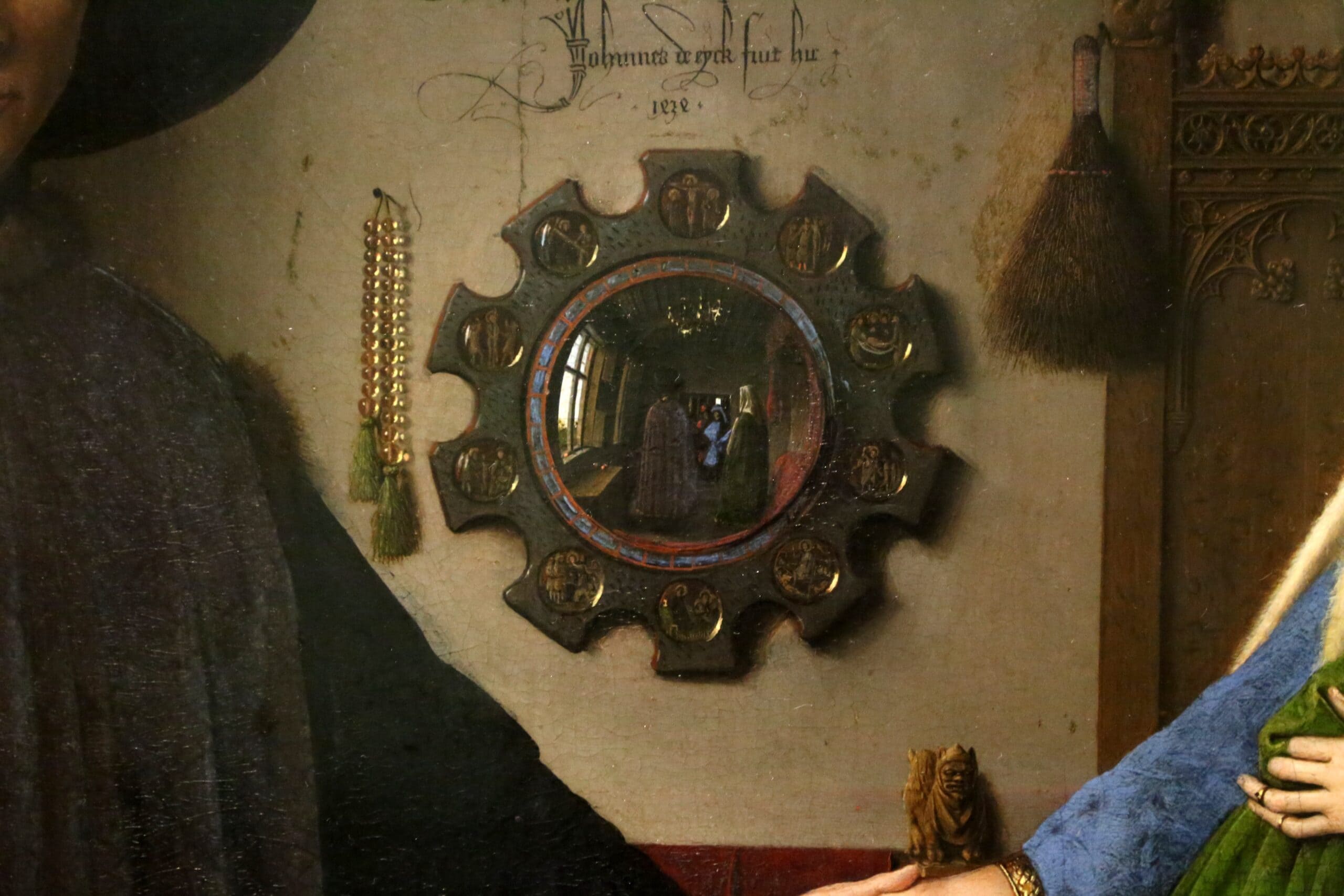
It is worth pausing over the question of what, exactly, was being guarded so jealously. Mirrors had existed since antiquity, after all — but for most of history, looking into one was like looking into a puddle. Polished bronze and silver gave back a reflection that was dark and murky. Medieval mirrors, made of glass backed with lead, were tiny and convex, and warped the face like the trick glasses of a funfair — it is precisely such a mirror that hangs on the wall in van Eyck’s famous portrait of the Arnolfini couple. Anyone who wished to see himself as he truly was simply had no means of doing so.
 Jan van Eyck, “The Arnolfini Portrait” (1434), National Gallery, London. Public domain.
 Jan van Eyck, “The Arnolfini Portrait” (1434), National Gallery, London. Public domain.
The Venetians solved the problem in two stages. The first was the glass itself: around the middle of the fifteenth century, Murano developed cristallo — Europe’s first truly colourless, transparent glass, so named because it resembled rock crystal. All earlier glass had carried a greenish or yellowish cast from its impurities; cristallo was as clear as water. The second stage was the reflective surface: in place of lead, the Venetians began coating the pane with an amalgam of tin and mercury, laid over flat, thinly blown glass. The union of these two technologies produced an effect Europe had never seen before: a large, flat, luminous mirror that, for the first time in history, showed a person a faithful reflection of himself.
Contemporaries wrote of the invention in the tone reserved for miracles: “a thing divinely beautiful, pure and flawless.” And no wonder — for people who had spent their whole lives regarding themselves in a dark, warped piece of metal, a glance into a Venetian mirror must have been an almost metaphysical experience. To see oneself sharply, in natural proportion and colour: a triviality today, but then a marvel whose price was measured in human lives.
 A Venetian mirror in a carved and gilded frame, early eighteenth century. The Metropolitan Museum of Art, New York (public domain).
 A mirror framed in engraved glass (verre églomisé), c. 1690. The Metropolitan Museum of Art, New York (public domain).
 A mirror of Venetian type, attributed to the seventeenth century, with chinoiserie decoration — a frame assembled from many engraved mirrored elements, its patina and the dark blotches of oxidised mercury clearly visible. Museo del Carmen de Maipú, Santiago, Chile. Photo: Jorge Barrios / Wikimedia Commons, CC BY-SA 3.0
The Mirror Craze
By the middle of the seventeenth century, France was in the grip of a genuine mirror craze. The mirror had ceased to be a small object of the dressing table and become wall decoration — and decoration of the highest order, displayed exactly as paintings were. When the Duchess de Longueville gave a reception, her salon was hung with fifty Venetian mirrors set side by side. Louis XIV had the chamber of his mistress, Louise de La Vallière, lined with a hundred and forty-four of them, each in a costly frame. The king himself was an insatiable customer: in the single year of 1665 he bought several thousand livres’ worth of mirrors from the Venetians.
The trouble was that every one of these mirrors had to be brought from Venice — and paid for at whatever price Venice chose to name. And the prices it named were vast: a large Venetian mirror in a rich frame could cost as much as a painting by a recognised master, and was sometimes likened to the price of a small ship. In 1665 alone, more than two hundred crates of Venetian mirrors passed through the French customs houses. The kingdom was spending at least a hundred thousand écus a year on them — and on Venetian lace, incidentally, three times as much. For Colbert, the finance minister wrestling with a chronic shortage of bullion, this was a haemorrhage at the very heart of the treasury: French gold was flowing in a broad stream into the coffers of a rival power, financing another nation’s industry and another nation’s fleet.
Colbert was an economist of iron consistency: if France could not stop buying luxury, then luxury would have to be made in France. Earlier attempts — and there had been a dozen or more over the century, from royal privileges for Italian glassworkers to experiments in provincial glasshouses — had come to nothing, for scattered, underfunded workshops stood no chance against the Venetian monopoly. From this Colbert drew a radical conclusion: cancel all the minor privileges and concentrate every effort in a single state enterprise, modelled on the royal manufactory of furniture and tapestry founded three years earlier.
 Jean-Baptiste Colbert, portrait by Claude Lefèbvre (1666). Public domain. (It was in this same year, 1666, that the first flawless mirror emerged from Colbert’s manufactory.)
In October 1665 Louis XIV signed the letters patent establishing the Royal Mirror Manufactory. The document opens with a sentence of almost poetic bureaucratic elegance: since peace brings the kingdom “great tranquillity,” the monarch intends to devote his care to all that might bring it “not only abundance, but also ornament and embellishment.” Behind the courtly phrasing lay an economic programme — and something else besides: a discreet admission that the crown had “invited, through our benefactions, foreigners.”
Foreigners. In that one word was contained the whole operation — one we would today call, without hesitation, industrial espionage — and which in Venice was a crime punishable by death.
A Spy Novel
What happened between Venice and Paris in the years 1664 to 1667 is known to us not from legend but from documents. In the late nineteenth century the archivist Elphège Frémy dug through the Venetian diplomatic records — several dozen dispatches and letters exchanged between the Republic and its ambassadors in France — and reconstructed from them, step by step, a story he himself called a spy novel. It would be hard to find a better description.
It began in 1664, when France’s ambassador to Venice, Pierre de Bonzi — Bishop of Béziers, of an old Florentine family — received from Colbert the mission of quietly recruiting masters from Murano. The ambassador’s reply was sober: he informed the minister that the laws protecting the Venetian glassworkers were so draconian that anyone who so much as proposed a move to France risked “being thrown into the sea.” And then — for the good of the kingdom — he took the task on. The plan had two stages: first to single out the craftsmen most susceptible to French gold, then to spirit them under escort to Paris, all without the Council of Ten getting wind of it.
To Murano itself Bonzi sent a man who aroused no suspicion: a shrewd dealer in second-hand goods. After three months the go-between reported that he had found willing men. In the summer of 1665 three masters of cristallo — La Motta, Pietro Rigo and Zuane Dandolo — reached Paris without incident and set about building the first furnaces. Venice discovered the escape too late: a search of the go-between’s house did turn up incriminating notes, but the fugitives were already beyond reach.
The second expedition had the dramatic shape of a ready-made film script. The party was led by Antonio della Rivetta, and its departure was hastened by a remark overheard in a gondola — two Venetians were discussing a newcomer “of such and such an appearance” who was moving about the city bribing glassworkers, and agreeing that the authorities must be told. They fled by night: at four in the morning, after farewells to their families, the men climbed into a boat; by dawn they were in Ferrara, from where carriages carried them through Turin to Lyon. There a surprise awaited them — someone had contrived to offer them two thousand pistoles to stay in the town. It nearly came to blows; four turned back, and the rest went on to Paris.
 The interior of the royal manufactory: a blazing furnace and the workers tending it. Mirror-making required furnaces kept in perpetual fire — to let one go out meant enormous losses. Plate from Diderot and d’Alembert’s “Encyclopédie” (c. 1765). Public domain.
Colbert paid like a king. Della Rivetta, on whose talent everything rested, was given an annual salary of twelve hundred livres, his closest companions eight hundred apiece — for comparison, one often cites the salaries of the literary stars of the day: Molière received a thousand, Racine six hundred. In the autumn of 1665 the manufactory in the Saint-Antoine district opened with a team of twenty Italians, and on 22 February 1666 the first flawless mirror came out of it. Dunoyer, the director, sent it to Colbert like a trophy. In April Louis XIV himself came out to the manufactory with his court: he watched a pane being blown, polished and coated with amalgam before his eyes, asked questions, and on leaving pressed a handsome tip on the workmen.
Venice, meanwhile, had no intention of letting the matter drop — it simply worked in the dark. Its ambassadors in Paris were given a plain instruction: sabotage the manufactory by any means. Threats were set in motion, promises of amnesty, rumours (word was put about, for instance, that French mirrors cracked in frost and heat) — and forgeries. When Colbert, hoping to bind the Italians to France, began bringing their wives over from Murano, the Venetian police intercepted the correspondence and fabricated replies: the wives were supposedly refusing to leave and summoning their husbands home. A footman planted in the ambassador’s household delivered the letters in person to the rue de Reuilly and watched the readers’ faces. The ruse misfired — the glassworkers noticed that the letters had been written by “a person of knowledge and intelligence surpassing” that of their wives, and gave them no credence.
The operation to smuggle out the wives is a gem in its own right. In the summer of 1666 the Venetian police, forewarned of the French agents, searched the glassworkers’ marital homes — and found a picture of pure resignation: women waiting patiently for their husbands, one laid low by grave illness in her bed, another pressing on the inquisitor a beseeching plea for her husband’s return to the “nest.” A few days later the inspectors came back — and were dumbfounded. The nest was empty. The invalids had all recovered at once, and together with the French agent had too great a head start to be caught.
That is not to say all was idyllic in Paris. Spoilt by royal favour — housed, fed and lavishly paid — the glassworkers soon earned a reputation for being difficult: they entertained “not overly bashful” Parisiennes in their lodgings, multiplied their demands, and guarded their knowledge closely, keeping the French workmen well away from the furnaces. The Italian colony split, moreover, into two warring camps — La Motta could not abide Rivetta’s successes — while Venice’s agents eagerly fanned the flames. The rivalry ended in gunfire: both factions were armed with arquebuses, a shot was fired, La Motta was wounded in the arm, and the royal guard had to step in. The manufactory stood idle for several days while the furnaces — which could not be allowed to go out — devoured a fortune.
And then the deaths began. In early January 1667 the first of the masters died suddenly — the very man without whom the glass melt could not be prepared. On 25 January death took the second, Domenico Morasso. Dunoyer demanded an autopsy; the suspicion that the hand of the Most Serene Republic lay behind both deaths suggested itself readily enough — though in fairness it must be added that no proof has been found to this day. At the same time, on Murano, the inquisitors shut four glassworkers suspected of intending to emigrate into the notorious Piombi prison. The message was legible on both sides of the Alps.
And legible to effect. The terrified Italians concluded that no salary was worth their lives. The Venetian ambassador, mixing threats with the promise of amnesty, got his way: in April 1667 della Rivetta and his closest companions left France. Venice, it must be granted, kept its word — no one laid a finger on them. Their fellows on Murano, on the other hand, made life so unbearable for the “traitors” that the men had to seek the protection of the Council of Ten itself. Colbert supplied the bitter epilogue: when, three years later, these same masters asked to be readmitted to Paris, the minister refused flatly — they had caused so much trouble and shown “so much malice” that he saw no advantage in their return.
For France no longer needed them. By trial and error, drawing on its own experiments — among them the work of the Norman glasshouse at Tourlaville — the manufactory began, around 1670, to achieve results that would soon outstrip the Venetian standard. The best testimony to the change is a dispatch of 1680 from the Venetian ambassador, complaining to his government that his “eyes were wet with tears” to watch an industry that providence and nature had so generously entrusted to Venice migrate to France, “abetted by the unpunished wickedness of certain of our own countrymen.” The monopoly, guarded for four hundred years by dagger and statute, had just ceased to exist.
The Reflection at Versailles
The finale of this story can be seen with one’s own eyes today — and several million tourists see it every year, mostly without knowing what they are looking at. The Hall of Mirrors at Versailles, designed by Jules Hardouin-Mansart and built between 1678 and 1684, was conceived as a manifesto: seventy-three metres of gallery in which seventeen great windows opening onto the gardens are answered by seventeen mirrored arcades on the opposite wall. Three hundred and fifty-seven mirrors in all — for each “pane” the visitor sees is in fact made up of twenty-one smaller panels, precisely fitted together. The technology did not yet allow sheets of this size in a single piece; the illusion of one seamless, luminous wall was achieved by the craftsman’s perfection of the joins.
 The Hall of Mirrors at Versailles — detail of the mirrored arcades. Each “pane” is in fact composed of many smaller mirrors fitted into a single luminous wall. Photo: Coyau / Wikimedia Commons, CC BY-SA 3.0


The secret that broke the Venetian monopoly: instead of blowing the sheet, the French poured molten glass straight onto a great table and spread it with a roller — which let them produce mirrors of a size beyond Murano’s reach. Plate from Diderot and d’Alembert’s “Encyclopédie” (c. 1765), drawn by Louis-Jacques Goussier. Public domain.
When the gallery was opened to the court in 1682, the chroniclers outdid one another in wonder. The “Mercure galant” wrote of a palace of delight that enchanted “sight, hearing, taste, and even smell,” of a “dazzling accumulation of riches and lights, multiplied a thousandfold in as many mirrors.” In a hall lit by thousands of candles, the court could at last behold itself entire — from the jewels in its hair to the buckles on its shoes. It would be hard to find a more fitting emblem of the age of the Sun King: an architecture whose principal subject is the reflection of its own magnificence.
But the gallery’s true message was political and economic — and every diplomat of the day read it without difficulty. All these mirrors had been made in France. A hall that, just twenty years earlier, would have had to be lined with Venetian glass at ruinous cost had become a showcase for the native manufactory — proof that France had not merely caught up with Venice but had just overtaken her. Here, alongside the silks of Lyon and the tapestries of the Paris workshops, something was born that we know to this day: the French luxury industry as an instrument of the prestige of the state.
What is more, the French soon stopped even imitating the Venetian methods. Towards the end of the century they developed a technique of casting glass on flat tables — instead of blowing it — which allowed them to produce sheets of a size beyond Murano’s reach. The pupils had not merely robbed the masters; they had reinvented the thing from scratch.
The manufactory where it all began exists to this day. After production moved to the village of Saint-Gobain in Picardy, it took the place’s name — and under that name, as one of the largest building-materials groups in the world, it has run without interruption for more than three hundred and fifty years. The glass pyramid of the Louvre? Their glass too. The story has come full circle: a company founded to steal from Venice the secret of transparency still glazes the most famous buildings on earth.
The mirror has become so ordinary to us that it is hard now to imagine a world in which it was a treasure. And yet we carry traces of that age in our habits still — in the reflex, for instance, of hanging a mirror opposite a window. The gesture was born in an age when a sheet of glass cost a fortune and had to earn its keep: doubling the candlelight, widening the room, letting a second garden in from beyond the window. The Hall of Mirrors is precisely that — one great window reflected in the opposite wall. When we repeat the trick in a modern flat, we are quoting, usually without knowing it, the Versailles of the seventeenth century.
It is worth remembering, too, that the objects we now call “Venetian mirrors” — the ones with etched, engraved frames built up from mirrored pieces — are for the most part the nineteenth-century grandchildren of this story, made on Murano after the island had recovered from its decline. The real stake of the tale, in any case, lies not in any particular object but in what it says about the nature of luxury: that its value never comes from the material itself, but from knowledge that others do not have. Venice understood this well enough to be ready to kill for it. France — well enough to be ready to steal.
And the secret itself? It dissolved, as all secrets do. A sheet of mirror is made today in a matter of minutes, by methods that make the amalgam of tin and mercury look like alchemy. All that remains of the whole story is a document that reads like a set of instructions for murder, seventy-three metres of glittering gallery outside Paris — and an object we look into every day without seeing anything remarkable in it at all.
Bibliography
- Sabine Melchior-Bonnet, Histoire du miroir, preface by Jean Delumeau, Éditions Imago, Paris 1994.
- W. Patrick McCray, Glassmaking in Renaissance Venice: The Fragile Craft, Ashgate, Aldershot 1999.
- Marie de Laubier, Saint-Gobain 1665–2015. Le passé du futur, preface by Pierre-André de Chalendar, Albin Michel, Paris 2015.
Quotations from French sources are given in the author’s own translation, after S. Melchior-Bonnet, op. cit. The account of Colbert’s recruitment operation is reconstructed from the Venetian diplomatic dispatches edited by Elphège Frémy (Archivio di Stato, Venice), cited in the same.
Further Reading
- Sabine Melchior-Bonnet, The Mirror: A History, trans. Katharine H. Jewett, Routledge, New York 2001 — the English edition of the book on which this essay is based.
- Mark Pendergrast, Mirror Mirror: A History of the Human Love Affair with Reflection, Basic Books, New York 2003 — a popular history of the mirror from antiquity to the present.
- Warren C. Scoville, Capitalism and French Glassmaking, 1640–1789, University of California Press, Berkeley 1950 — the classic monograph on the French glass industry, including the origins of Saint-Gobain.
- Paul Hills, Venetian Colour: Marble, Mosaic, Painting and Glass 1250–1550, Yale University Press, New Haven 1999 — on colour and glass in the visual culture of Venice.
- Sheldon Barr, Venetian Glass: Confections in Glass, 1855–1914, Harry N. Abrams, New York 1998 — on the nineteenth-century revival of Murano, the source of today’s “Venetian mirrors.”